
You've shipped prototypes that worked on the bench. Now a customer, distributor, or pilot partner wants real units, and suddenly the board isn't a learning exercise. It's inventory, warranty risk, and your name on a carton.
That's where most hardware founders get hurt on their first small batch. They shop for no MOQ and a low unit price, then discover mixed date codes, undocumented substitutions, weak test coverage, and packaging that doesn't survive freight. Low volume PCB assembly isn't a cheaper version of mass production. It's a traceability, counterfeit-risk, and lifecycle-data problem that happens to involve a smaller quantity.
Table of Contents
- What Low Volume PCB Assembly Actually Means
- Prototyping vs Low Volume vs Mass Production
- Inside the Low Volume Assembly Process
- Turnkey vs Consigned and the Sourcing Question
- Design for Manufacturing Tips and the Certification Map
- Counterfeit Risk and a Vendor Selection Checklist
- Logistics, Packaging, and a Small Case Sketch
- Frequently Asked Questions About Low Volume Assembly
<a id="what-low-volume-pcb-assembly-actually-means"></a>
What Low Volume PCB Assembly Actually Means
You've landed your first real order for 250 boards. Last month's prototypes proved the circuit works, but they didn't prove you can build the same thing repeatedly, source the same parts again, or explain exactly what went into unit 137 if a customer returns it.
That's the line you just crossed. Low volume PCB assembly covers production runs between engineering samples and continuous mass production, typically tens to low thousands of boards. Your goal is no longer learning whether the design works. Your goal is delivering saleable, supportable product without committing to demand you haven't proven yet.
<a id="who-belongs-in-this-category"></a>
Who Belongs in This Category
You're in this category if you're seeding a pilot launch, scaling a validated startup product past prototype, sustaining a niche industrial or medical SKU, or supplying R&D teams with replaceable, field-upgradeable boards. Quantity alone doesn't decide it. Documentation, repeatability, and customer exposure do.
Treat a small batch that will reach paying users as production, even if the quantity feels like a prototype. That shift changes what you should demand from your assembler. Ask how they measure first-pass yield, defect rates, inspection coverage, traceability, and test effectiveness, not just what each board costs.
Practical rule: If a customer can receive it, return it, or depend on it in the field, build it with production controls.
That expectation fits how the wider industry benchmarks quality. IPC's worldwide Quality Benchmarks study of 118 electronics assembly companies and PCB fabricators analyzed yields, defect rates in defects per million opportunities, inspection, testing, customer returns, and certification data. You're not too small for those controls. You're exactly the size where one undocumented change can consume your entire batch.
<a id="prototyping-vs-low-volume-vs-mass-production"></a>
Prototyping vs Low Volume vs Mass Production
Don't choose a process based on the label on a quote. A prototype run of 100 boards with locked documentation, approved parts, and functional test behaves like low-volume production. A five-board hack built to answer one technical question doesn't, even if an assembler calls both jobs prototypes. If you're still changing the design weekly, start with prototype PCB assembly built for fast learning before you lock a batch.
The economics shift across the three modes. Prototyping concentrates your spend on engineering learning, so high unit cost is acceptable when it buys speed. Low-volume work spreads stencil, setup, programming, and DFM review across too few units to hide waste, but still requires change control. Mass production amortizes tooling and setup across continuous runs, so yield optimization and line efficiency dominate the conversation.
<a id="production-modes-at-a-glance"></a>
Production Modes at a Glance
| Mode | Typical Quantity | Engineering Effort | Risk Focus | |---|---|---|---| | Prototyping | Often under 20 boards | Design validation and rapid revision | The circuit or firmware doesn't work | | Low volume | Tens to a few thousand | DFM, sourcing control, test definition | Inconsistent builds and undocumented parts | | Mass production | Thousands or more, continuous | Yield, tooling, and process optimization | Unit cost, capacity, and line stability |
Your risk focus should move with you. In prototyping, ask whether the board works. In low volume, ask whether every board is the same, whether you can prove what was installed, and whether you can reorder it without starting over. In mass production, ask whether the process stays economical and stable at speed.
That distinction is why low-volume buyers shouldn't copy a high-volume scorecard. You don't win by negotiating fractions off placement cost while leaving substitutions open. You win by locking the design, controlling the BOM, and building a record you can reuse on the next order.
<a id="inside-the-low-volume-assembly-process"></a>
Inside the Low Volume Assembly Process
Small batches punish sloppy preparation because there's no long run over which to recover from it. Your assembler sets up the same line, loads the same feeders, and profiles the same oven whether you're building a short batch or a long one. One preventable engineering question can stop the whole order.
<a id="from-review-to-reflow"></a>
From Review to Reflow
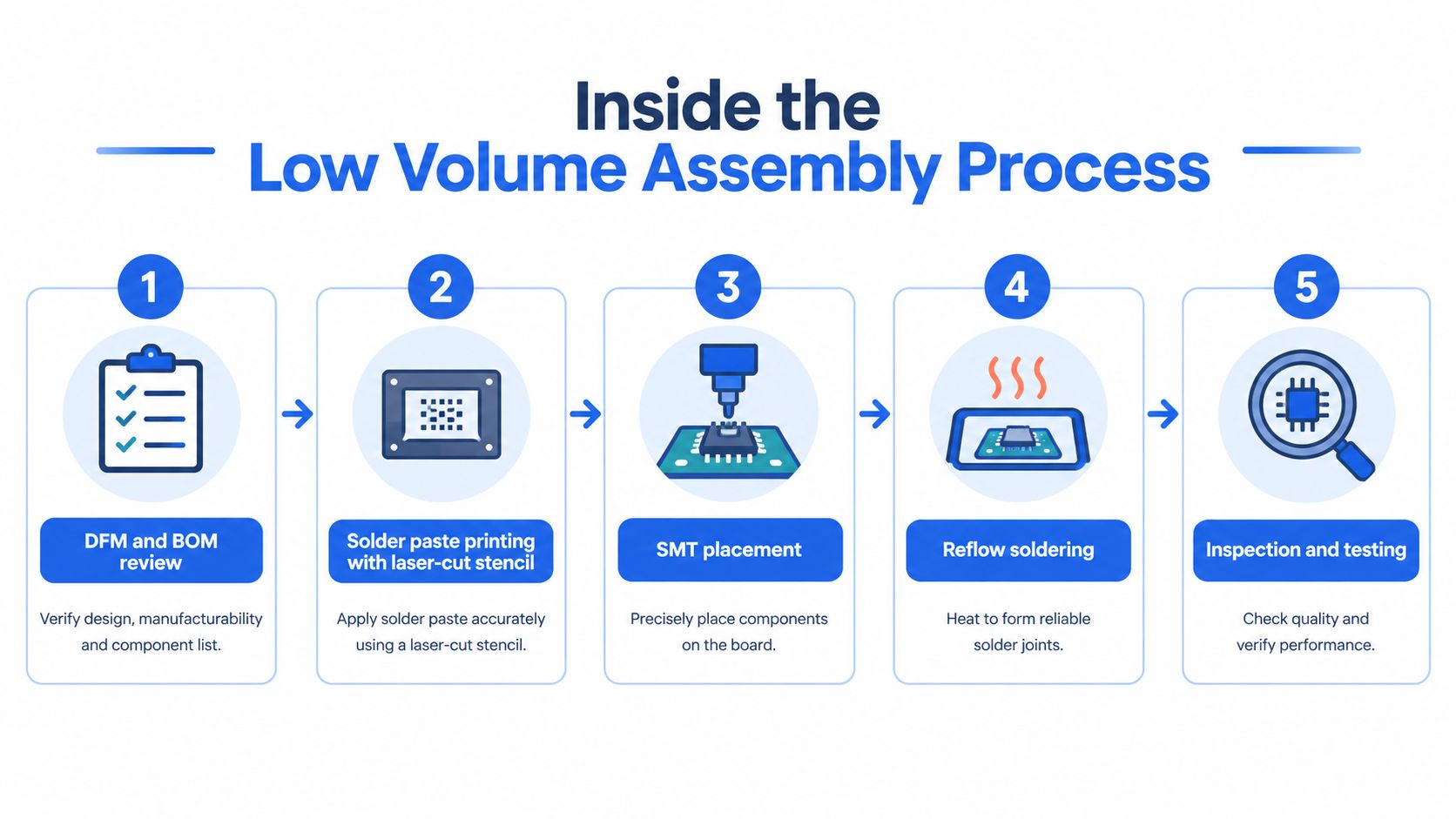
Start with DFM and BOM review. Insist on it before money moves. Your assembler should check footprints, polarity, package mismatches, obsolete parts, moisture sensitivity, and alternates while changes are still cheap. Don't accept a silent quote on a BOM nobody has challenged.
Next comes solder paste printing through a laser-cut stencil, followed by SMT placement. Modern lines handle 01005 components and fine-pitch BGA and QFN packages, but fine-pitch capability doesn't excuse poor paste control. Reflow profiling then has to match your board's thermal mass and component mix, not a generic profile pulled from the last job.
Mixed-technology boards add through-hole insertion after reflow. Connectors, transformers, and awkward mechanical parts may need selective or hand soldering. Ask which joints are machine soldered, which are hand soldered, and who inspects them. Hand work isn't a defect, but undocumented hand work is a variation source.
<a id="inspection-and-test-you-should-specify"></a>
Inspection and Test You Should Specify
- SPI: Confirms solder paste volume and registration before components hide printing defects.
- AOI: Checks placement, polarity, tombstoning, bridging, and visible solder joints after reflow.
- X-ray: Reveals voiding and hidden joints under BGAs and QFNs that optical systems can't see.
- Flying-probe or functional test: Verifies electrical behavior, with functional test preferred when the board must operate as a system.
Don't buy inspection as a logo on a capability slide. Specify which boards receive it, what criteria define a failure, and what records you'll receive.
For a low-volume order, I recommend 100% AOI, X-ray on hidden-joint devices, and a defined functional test whenever the consequences of a dead board exceed the assembly price. Skipping test doesn't remove cost. It transfers that cost to your bench, your customer, or your returns pile.
<a id="turnkey-vs-consigned-and-the-sourcing-question"></a>
Turnkey vs Consigned and the Sourcing Question
For most small batches, choose turnkey assembly unless you already control valuable, scarce, or customer-mandated parts. In a turnkey model, the assembler sources the bare PCB, components, and stencil. In a consigned model, you supply the parts and carry the shortage, kitting, attrition, and reel-format problems yourself. A clear turnkey PCB assembly process gives you one accountable owner for that chain.
Turnkey wins on schedule because your assembler can order through established distributor accounts, use cut-tape support for partial quantities, and coordinate PCB fabrication with component arrival. It also concentrates risk. If you don't require visibility, you won't know whether a resistor came from an authorized distributor, old stock, or an undocumented substitute.
Geography makes that visibility more important. IPC reported that European PCB production was approximately €2 billion annually, about 2% of global production, compared with roughly 20% in the 1990s. Capacity has consolidated globally, so supplier qualification, lead-time control, and cross-border logistics aren't administrative extras. They're operating requirements.
<a id="how-to-structure-the-purchase"></a>
How to Structure the Purchase
Put sourcing rules in writing before releasing the order:
- Approved sources: Name authorized distributors and prohibit broker purchases without your written approval.
- Approved alternates: List acceptable manufacturer part numbers in the BOM, not in an email thread.
- Evidence: Require lot and date-code records for semiconductors and other critical parts.
- Shortage handling: Require the assembler to stop and ask rather than substitute to protect a ship date.
Consignment can still make sense for programmed devices, customer-owned inventory, or parts under your direct quality agreement. If you consign, send overage for setup and attrition and label every reel with manufacturer, part number, lot, and date code. Do not send a bag of loose parts and expect production-grade traceability.
<a id="design-for-manufacturing-tips-and-the-certification-map"></a>
Design for Manufacturing Tips and the Certification Map
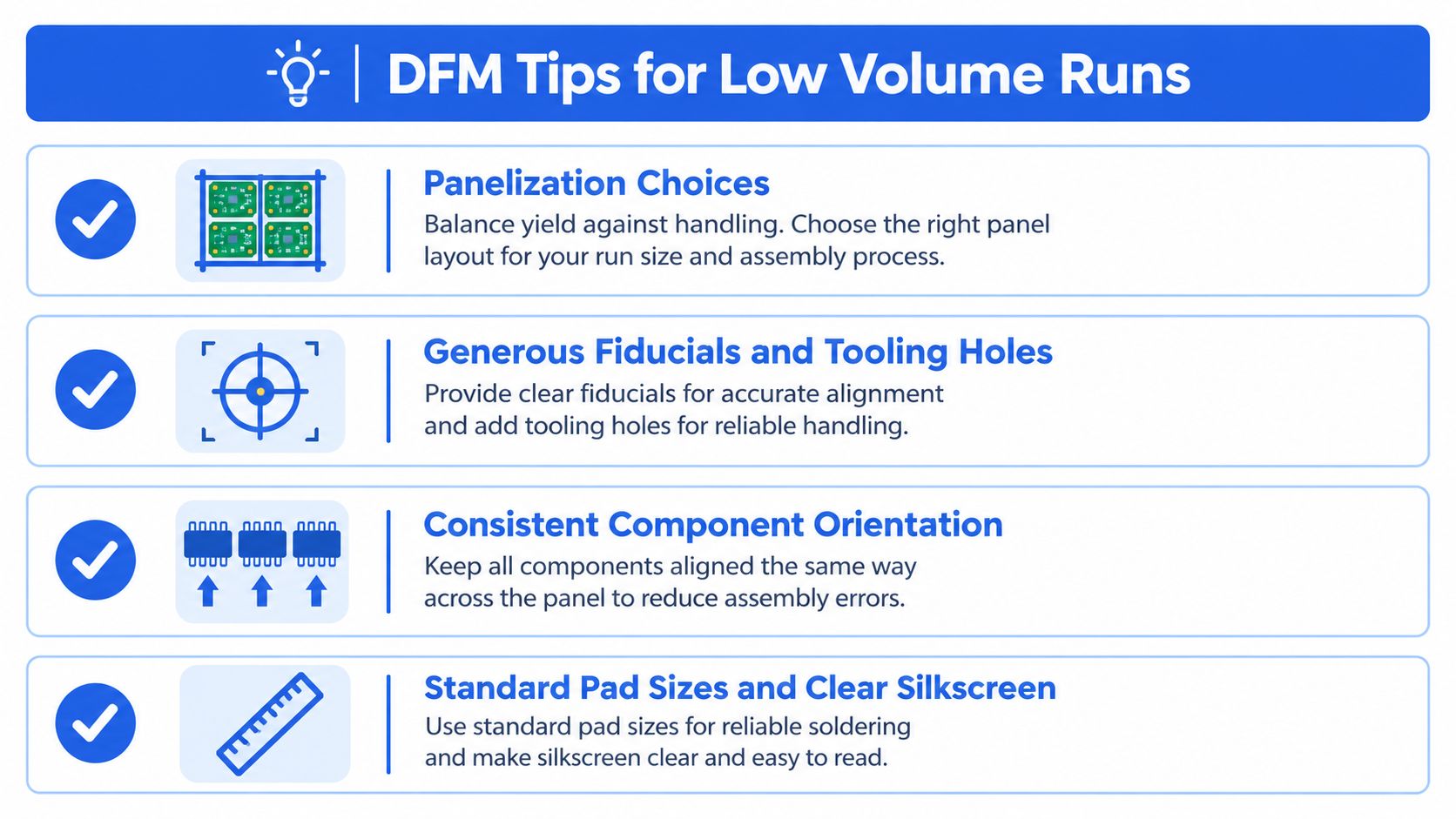
Good low-volume DFM isn't about making your board pretty. It's about removing touches, ambiguity, and rework from a run that can't absorb them. Every awkward orientation, missing fiducial, or unclear polarity mark becomes operator judgment.
<a id="dfm-moves-that-pay-off-quickly"></a>
DFM Moves That Pay Off Quickly
- Panelize deliberately: Balance material yield against handling, depaneling stress, and test access.
- Add fiducials and tooling holes: Give printers, placement machines, and fixtures unambiguous references.
- Keep orientation consistent: Align polarized parts the same way wherever layout permits, reducing placement and inspection errors.
- Design for rework: Use sensible pads and solder mask clearances so a technician can replace a part without damaging neighboring joints.
- Mark what matters: Show polarity, pin one, revision, and a traceable board identifier in silkscreen or another durable marking.
Then match certifications to your actual market instead of collecting logos. Review the scope behind PCB assembly certifications and quality systems before treating any certificate as evidence for your product.
ISO 9001 signals a baseline quality management system. ISO 13485 is the relevant medical-device discipline. IATF 16949 addresses automotive quality expectations. UL relates to safety-critical listings for applicable products and materials. RoHS concerns restricted substances, not overall manufacturing quality.
A certificate only helps if its scope covers the site, process, and product you're buying.
Ask for the certificate, expiry, registrar, and site scope. If your customer requires medical or automotive controls, a generic quality claim isn't enough. If you're building a benign consumer accessory, paying for irrelevant controls may add cost without reducing your actual risk. Buy the evidence your market demands, and refuse paper shields.
<a id="counterfeit-risk-and-a-vendor-selection-checklist"></a>
Counterfeit Risk and a Vendor Selection Checklist
Here's my direct position: no MOQ can increase unit-level risk. Small orders are often filled from fragmented reels, mixed date codes, and broker stock assembled to meet a quantity nobody planned carefully. You receive flexibility at the order desk and uncertainty inside the BOM.
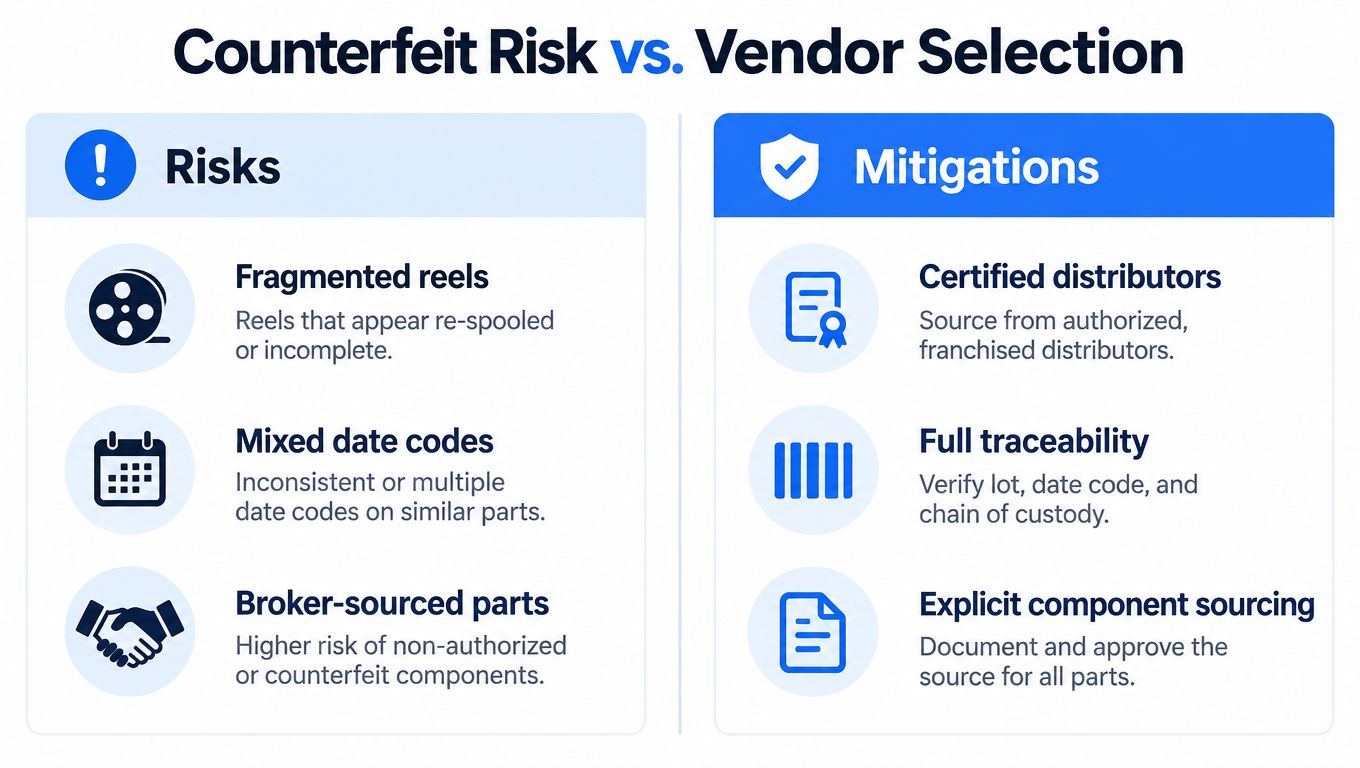
That concern is supported by the 25% year-over-year increase in suspect counterfeit and nonconforming parts and the 41% of organizations lacking complete visibility into supplier country of origin described in a low-volume defense electronics manufacturing discussion. Long lead times push teams toward secondary markets, where refurbished parts, unauthorized substitutions, and incomplete origin records become harder to detect.
<a id="build-a-component-risk-score"></a>
Build a Component Risk Score
Classify every line item before you approve sourcing:
- Criticality: Score parts by safety, performance, calibration, RF behavior, and field-failure consequence.
- Evidence required: For high-risk parts, require manufacturer traceability, lot records, and certificates of conformance.
- Source rule: Accept factory-sealed authorized stock by default. Treat broker stock as a formal deviation, never a routine shortcut.
- Incoming inspection: Define visual inspection, X-ray, electrical testing, or decapsulation for critical semiconductors when provenance is imperfect.
- Deviation approval: Require your written sign-off for alternates, date-code exceptions, refurbished stock, or incomplete records.
This matters most in medical, automotive, industrial, and RF products. Your batch may be small, but your evidence burden isn't.
<a id="score-vendors-on-evidence"></a>
Score Vendors on Evidence
Use the same checklist for every bidder. Score authorized sourcing, BOM review quality, traceability records, inspection coverage, test capability, relevant certifications, change control, packaging, and logistics transparency. Add lifecycle data to the request, including board mass, copper weight, scrap and rework records, shipment mode, material declarations, and end-of-life route. That broader view is consistent with research identifying electricity-intensive manufacturing, copper-intensive materials, and chemically intensive waste management as major PCB environmental hotspots.
Disqualify any vendor that won't state where parts come from or reserves the right to substitute without notice. A responsive sales contact doesn't compensate for an uncontrolled BOM.
<a id="logistics-packaging-and-a-small-case-sketch"></a>
Logistics, Packaging, and a Small Case Sketch
Boards can survive assembly and fail in the carton. Packaging is part of the build specification, so put it on the purchase order instead of leaving it to whoever closes the box. The protective packing below shows the handling standard you should expect before boards enter freight.
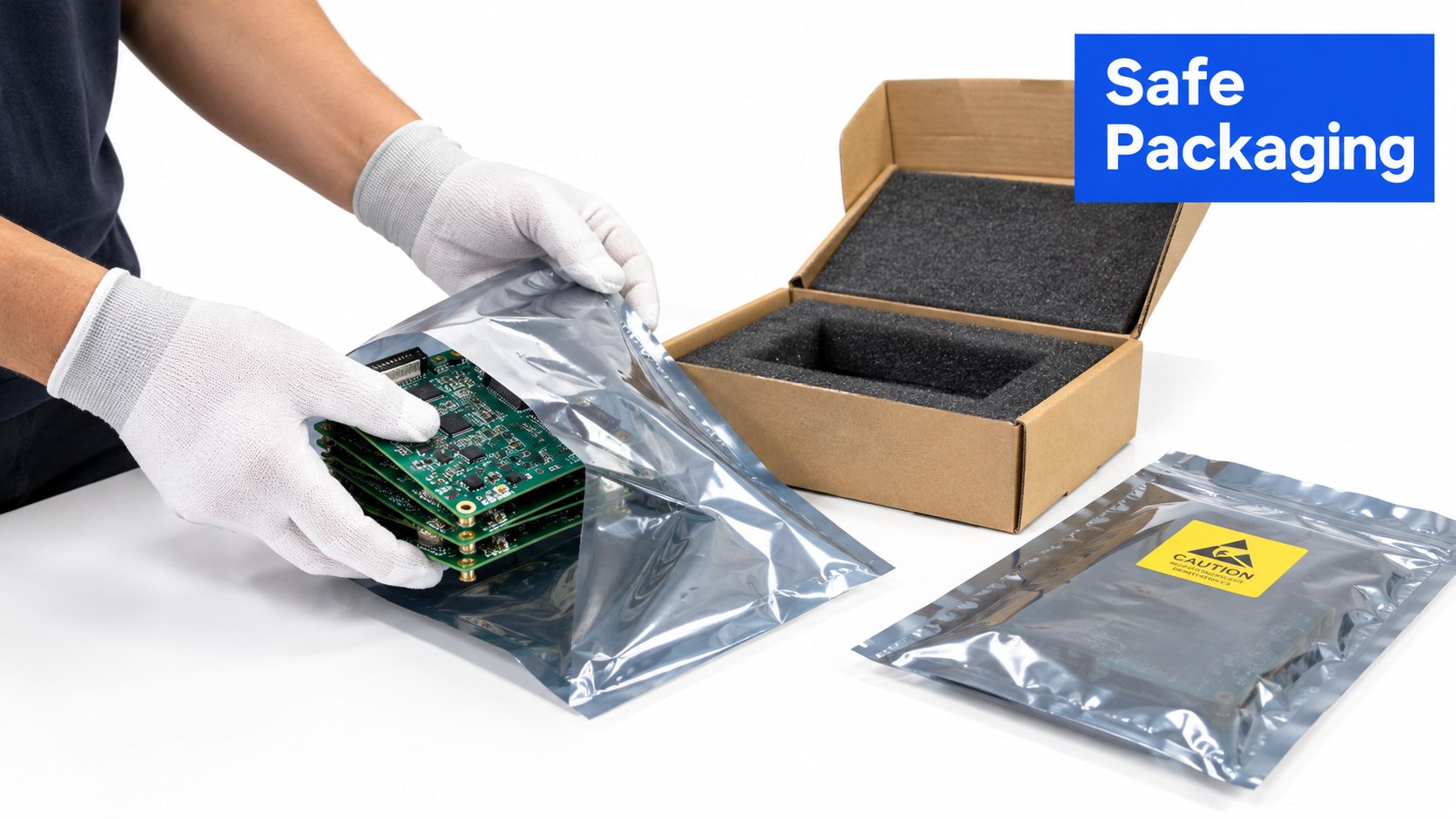
Specify ESD bagging for assembled boards, foam-lined cartons where connectors or tall parts need protection, and vacuum sealing with moisture controls for moisture-sensitive devices when storage or transit requires it. Labels should identify part number, revision, quantity, lot, and date clearly enough to survive warehouse and cross-border handling. If boards ship as panels, state that. If you need individual packing, state that too.
Courier choice won't rescue incomplete engineering, but DHL, UPS, and FedEx can compress transit once the build is ready. Shenzhen's shipping corridor helps only after fabrication, sourcing, assembly, test, and export paperwork are aligned. Ask your assembler for the constraint by name, whether that's a component, stencil, test fixture, or your own approval.
<a id="a-500-board-case-sketch"></a>
A 500-Board Case Sketch
A hardware team orders 500 mixed-technology boards turnkey on a Wednesday. They accept a one-week DFM window because two parts need approved alternates and one connector needs a hand-solder instruction. By the following Wednesday, they receive finished, tested, boxed units, fly part of the batch to pilot customers, and hold the remainder as first-pilot spares.
The video below gives a useful view of the production environment behind that kind of handoff.
<iframe width="100%" style="aspect-ratio: 16 / 9;" src="https://www.youtube.com/embed/qDSCwKZTSW0" frameborder="0" allow="autoplay; encrypted-media" allowfullscreen></iframe>That schedule works because the team didn't treat speed as a courier upgrade. They froze the BOM, approved deviations early, defined test, and specified packaging before assembly started. That's the repeatable lesson. Fast low-volume work is mostly disciplined preparation.
<a id="frequently-asked-questions-about-low-volume-assembly"></a>
Frequently Asked Questions About Low Volume Assembly
<a id="what-order-size-counts-as-low-volume"></a>
What Order Size Counts as Low Volume
There's no universal threshold. Tens to low thousands of boards is the practical range, but documentation and customer exposure matter more than the count. If units will be sold, installed, or used for formal validation, run the order as low-volume production.
<a id="how-fast-can-a-turnkey-build-move"></a>
How Fast Can a Turnkey Build Move
Lead time is set by the slowest input, usually PCB fabrication, scarce components, stencil or fixture readiness, or your approval of DFM questions. Don't accept a headline assembly time until the assembler confirms every critical BOM line. Ask for a dated material-clear date, then judge the promise.
<a id="what-happens-if-you-need-an-engineering-change-mid-run"></a>
What Happens if You Need an Engineering Change Mid-Run
Stop and classify the change before approving it. A firmware-only update may need relabeling and retest, while a component or footprint change can affect sourcing, stencil, placement, inspection, and traceability. Record which serials or lots contain each revision. Never let a verbal fix split one batch into undocumented variants.
<a id="how-does-a-small-run-become-ongoing-production"></a>
How Does a Small Run Become Ongoing Production
Keep the same controlled Gerbers, BOM, approved alternates, test procedure, work instructions, and packaging specification. Review yield, rework, returns, and sourcing problems after the first batch, then revise deliberately. You shouldn't need a redesign if the first low-volume build was documented as production from the start.
If you need a small batch built with controlled sourcing, DFM and BOM review, SMT and THT assembly, inspection, testing, and global shipping, talk to Lianyuhong Technology Co.,Ltd before you release the order. Send your Gerbers, BOM, pick-and-place files, critical-part list, and test requirements, and ask for sourcing evidence and a material-clear plan alongside the quote.