
The design passed review on Wednesday. By Friday afternoon, the demo is set for Monday, the board is still unbuilt, and the supplier quotes all sound reassuringly fast. But the assembly line isn't the only clock that matters. A missing component, unclear revision, or unresolved solder-process question can consume more time than the build itself.
That's why quick turn PCB assembly is a program decision, not just a rush order. The useful question isn't how soon boards can ship. It's whether the chosen schedule gets you to a working, trustworthy prototype without triggering a costly second build.
Table of Contents
- The Friday Afternoon Prototype Problem
- What Quick Turn PCB Assembly Actually Means
- Typical Turnaround Tiers and What Each One Delivers
- Technical Capabilities That Define the Envelope
- DFM and BOM Checklist Before You Hit Send
- Cost, Lead Time, and the Real Bottleneck
- Inspection, Testing, and Certifications That Matter
- Turnkey Versus Consignment and How to Decide
<a id="the-friday-afternoon-prototype-problem"></a>
The Friday Afternoon Prototype Problem
On Friday, an engineer with a Monday demo doesn't need a generic promise about “fast PCB lead times.” They need to know whether the assembler has the right files, whether every part is available, and whether the board can be assembled and checked in time to reveal anything useful before the meeting.
Bare-board fabrication is only one part of the schedule. A fab may finish the PCB quickly, but assembly still depends on component procurement, stencil preparation, engineering review, placement, soldering, inspection, and any required functional testing. If a BOM lists a part that's unavailable, or the centroid file doesn't match the board revision, the build can stop before production begins.
<a id="speed-time-and-quality-are-linked"></a>
Speed, time, and quality are linked
Quick-turn vendors sell speed, but a customer needs usable boards, not a shipment that merely left the building on time. A rushed build with unapproved substitutions or skipped inspection can look like a schedule win until bring-up exposes a fault and forces another iteration.
A better way to judge the offer is to ask what the quoted schedule includes and what must be true before its clock starts. Does the lead time begin after file approval, after all components arrive, or when the order is placed? Which inspection and tests are included? Who contacts you if a part doesn't match the package or the approved source?
Practical rule: Treat the schedule as a chain of handoffs. Find the slowest unresolved handoff before paying to accelerate the rest.
The point of quick turn is to shorten the path from design files to a board that can answer engineering questions. That requires coordination across fabrication, sourcing, assembly, and verification. A vendor's advertised lead time is useful only when it describes that full path clearly.
<a id="what-quick-turn-pcb-assembly-actually-means"></a>
What Quick Turn PCB Assembly Actually Means
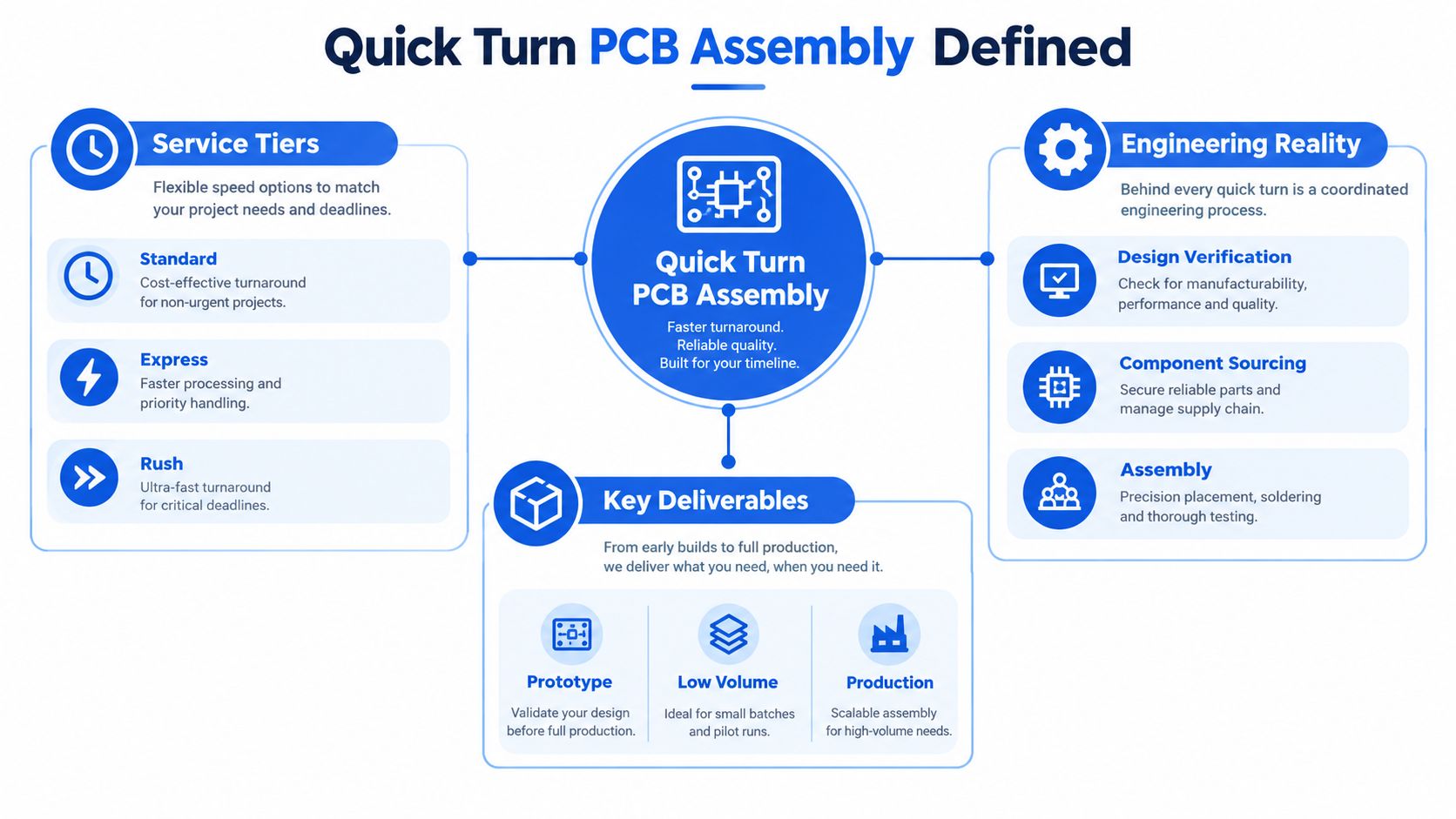
Quick-turn PCB assembly is an accelerated, coordinated service that takes a design package through component verification and sourcing, stencil preparation, surface-mount technology (SMT) and through-hole technology (THT) placement, soldering, inspection, and any agreed testing. Some suppliers also coordinate bare-board fabrication, so the customer can manage the board and assembly under one purchase order.
That's different from quick-turn PCB fabrication, which delivers bare boards without components. If you need a functioning prototype, confirm that the quote includes population, soldering, and the inspection needed for your package types. “PCB lead time” and “assembled-board lead time” aren't interchangeable.
<a id="map-the-work-not-just-the-delivery-date"></a>
Map the work, not just the delivery date
A schedule tier only means something when you understand the work it covers. Ask the supplier to identify the milestones from data review through shipment, along with customer approvals or incoming materials that can pause progress.
- Engineering review: The assembler checks files, footprints, assembly notes, and the BOM for conflicts that could stop the line.
- Materials and tooling: Components must be verified and available, and the stencil must match the design revision.
- Assembly and verification: The boards are populated, soldered, inspected, and tested according to the agreed requirements.
Low-quantity prototype and small-batch work may be offered without a minimum order quantity, but that doesn't mean every order has the same setup or sourcing economics. A turnkey quote can consolidate board fabrication, stencil, component sourcing, and assembly. Confirm which of those are included, which are customer-supplied, and how substitutions are approved.
IPC's development from an organization founded by six PCB manufacturing companies in 1957 to a broader electronics-industry association helped establish shared technical language for assembly requirements. Its assembly-related standards address processes and acceptance criteria that support communication between customers and suppliers across prototypes and production transfers (IPC assembly standards history and context).
<a id="typical-turnaround-tiers-and-what-each-one-delivers"></a>
Typical Turnaround Tiers and What Each One Delivers
A faster tier is useful only when the work can enter production. A 24-hour assembly option may be achievable when materials are already available and the design package is ready for release. If the assembler must clarify a footprint, source a missing part, or wait for approval of an alternate, the order won't move at the advertised pace.
The right comparison is not “fast versus slow.” It's how much preparation each lane requires, what work is included, and whether the added urgency removes a real bottleneck. A small prototype with approved parts may suit an express run; a more involved mixed-technology build can need additional time for setup, inspection, and test.
| Lead Time | Typical Order | Customer Prep | Cost Lever | |---|---|---|---| | 24 hours | A simple prototype with materials ready | Release revision-controlled files, confirm every part, and preapprove substitutions | Expedited setup and priority handling | | 72 hours | A prototype needing routine sourcing or a more involved assembly flow | Resolve BOM questions early and agree on the inspection plan | Component availability, setup, and shipping choice | | 5–10 days | A small batch or low-volume build with broader coordination | Confirm quantities, documentation, and test requirements before release | Batch setup, materials purchasing, and logistics |
<a id="choose-the-lane-that-fits-the-actual-work"></a>
Choose the lane that fits the actual work
A customer who pays for an express slot before confirming component availability may buy urgency without buying progress. Conversely, choosing a slower tier just to reduce the quote can be a false saving if it delays a design decision that blocks the next engineering step.
Ask the vendor to define the starting point and the stopping point of the quoted lead time. “After files are approved” differs from “after materials are received,” and “ready to ship” differs from “tested and documented.” Put the answers in the quote.
For a prototype, the best tier is often the one that gets enough boards through the right checks to answer the next technical question. If the build needs special testing or a complicated assembly sequence, plan around that work rather than treating it as an afterthought.
<a id="technical-capabilities-that-define-the-envelope"></a>
Technical Capabilities That Define the Envelope
A quick schedule is credible only if the supplier's process can handle the board as designed. Package size, pitch, mixed technology, and stencil requirements all affect whether the assembly is straightforward or needs additional engineering attention.
<a id="package-and-placement-limits"></a>
Package and placement limits
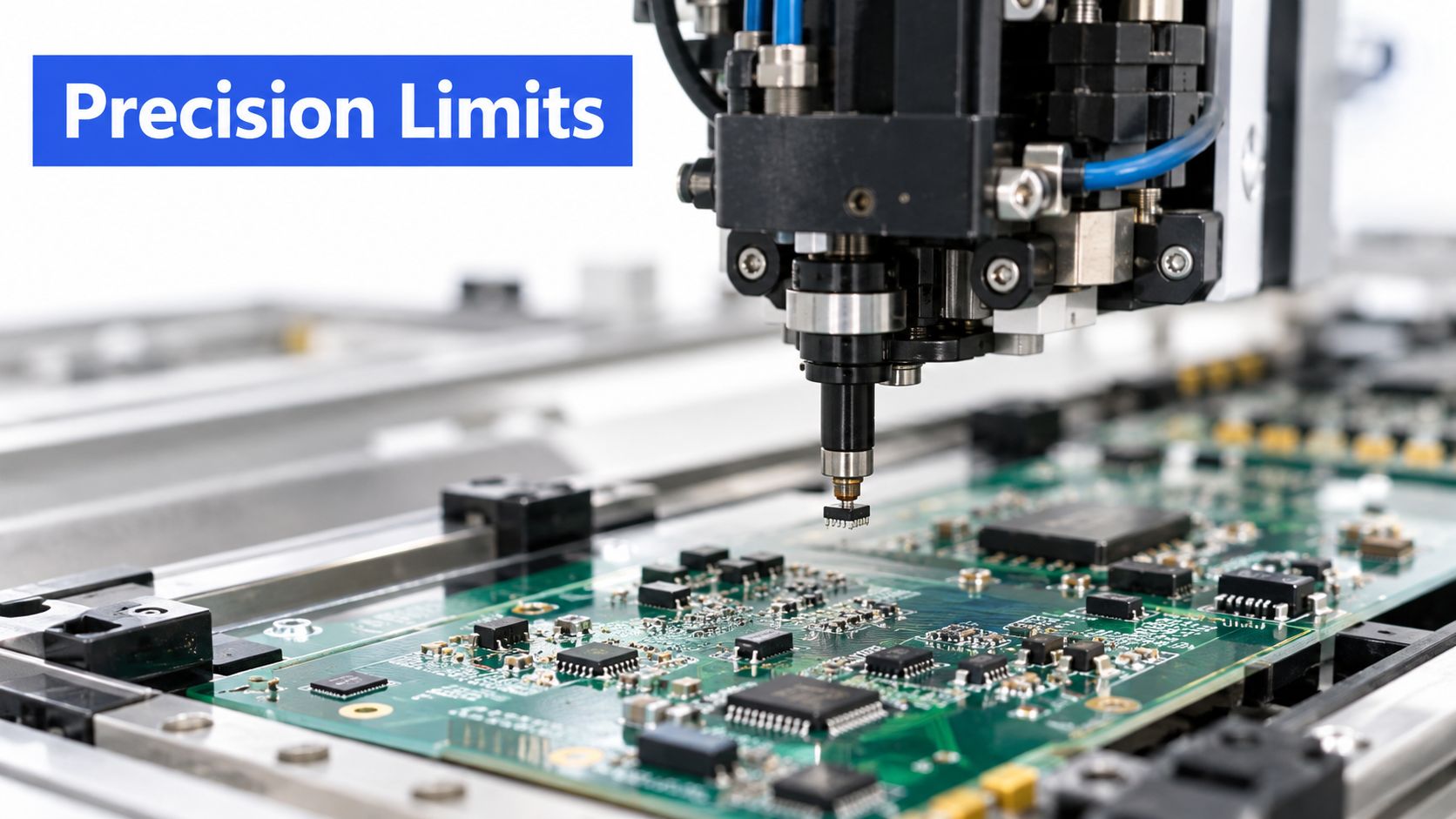
Ask whether the assembler routinely handles your smallest passive parts and your finest-pitch devices. A machine's nominal placement capability doesn't guarantee that a particular footprint, board finish, or solder-paste design will yield a dependable assembly. Fine-pitch QFN and BGA parts also create hidden joints, so inspection needs to account for connections that can't be judged from the top side.
Mixed SMT and THT boards introduce another coordination question. The supplier should confirm the soldering sequence, access for manual or selective soldering, and whether mechanical parts or connectors need special handling. A design that combines bottom-side parts, tall components, or unusual thermal mass can affect process flow.
<a id="stencils-and-sourcing-are-part-of-capability"></a>
Stencils and sourcing are part of capability
The stencil controls solder-paste deposition. Laser-cut stainless steel with a suitable finish, including nano or electropolish options, can support the intended paste release, but the aperture design still has to suit the component geometry. Ask the assembler to review the stencil requirements alongside the land patterns, not after the board is already queued.
Component sourcing is another boundary. Authorized distribution, traceable lot records, cut-tape support for prototypes, and a preapproved alternate matrix can keep a small build moving without leaving substitutions to an informal email exchange. If an alternate changes package dimensions, pinout, or electrical behavior, it can trigger a fresh review and invalidate the placement data.
A technically capable supplier should tell you where the design needs attention before quoting an aggressive schedule. Lianyuhong Technology Co.,Ltd provides SMT and THT assembly, including fine-pitch work, stencil options, and engineering review as part of its PCB services. The useful question for any supplier is how its stated capabilities apply to your specific board, components, and inspection needs.
<a id="dfm-and-bom-checklist-before-you-hit-send"></a>
DFM and BOM Checklist Before You Hit Send
The fastest way to lose time is to send a package that looks complete but contains mismatched revisions. A clean release gives the assembler one authoritative source for board data, component identities, placement, and test expectations.
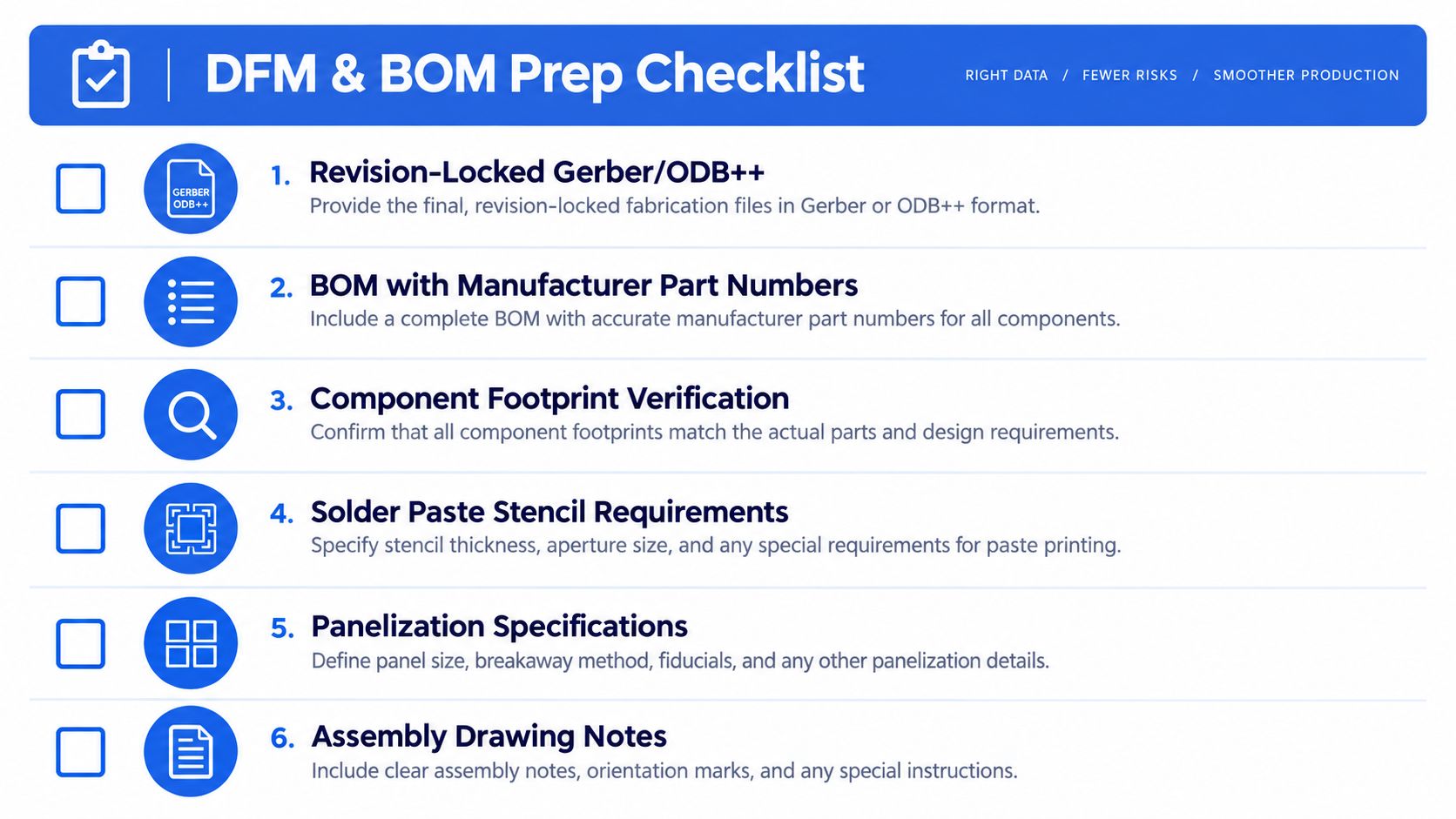
Use this checklist before issuing the purchase order:
- Lock the board revision: Provide revision-controlled Gerber or ODB++ data, and make sure the assembly drawing identifies the same release.
- Synchronize placement and BOM: Check that centroid data, reference designators, quantities, and manufacturer part numbers agree.
- Cross-check the schematic: Confirm that populated, do-not-populate, and alternate components match the intended electrical design.
- Verify footprints: Compare package dimensions and pin mapping against the selected parts, especially when an alternate is proposed.
- Document handling needs: Flag moisture-sensitive devices, polarity, orientation, and any special storage or baking instructions.
- Set panelization and tooling expectations: State whether the supplier should panelize, and identify fiducials, rails, and stencil requirements.
- Define inspection and testing: Specify what the assembler should inspect and which functional or electrical checks are required.
<a id="treat-ambiguity-as-a-schedule-risk"></a>
Treat ambiguity as a schedule risk
An incomplete BOM can cause a chain reaction. The supplier asks about a missing manufacturer part number, procurement suggests a substitute, engineering discovers a package or electrical difference, and the order waits for a revised placement or design review. That clarification loop can cost more elapsed time than resolving the question before release.
For each approved alternate, record the manufacturer part number and the conditions under which it can be used. If no alternate is acceptable, say so explicitly. The same applies to DNP items and test requirements. “Build per files” isn't enough when the files disagree.
For a fuller preparation workflow, use this PCB prototype assembly overview as a reference while assembling your release package. Then ask the supplier to confirm in writing that the files, BOM, and revision are aligned before materials are committed.
<a id="cost-lead-time-and-the-real-bottleneck"></a>
Cost, Lead Time, and the Real Bottleneck
The expedite line on a quote isn't the whole cost of speed. A rushed stencil, partial reels, distributor lot charges, air freight, engineering changes, and a respin can all affect the total bill. Some costs buy real schedule reduction. Others accelerate a step that wasn't holding up the build.
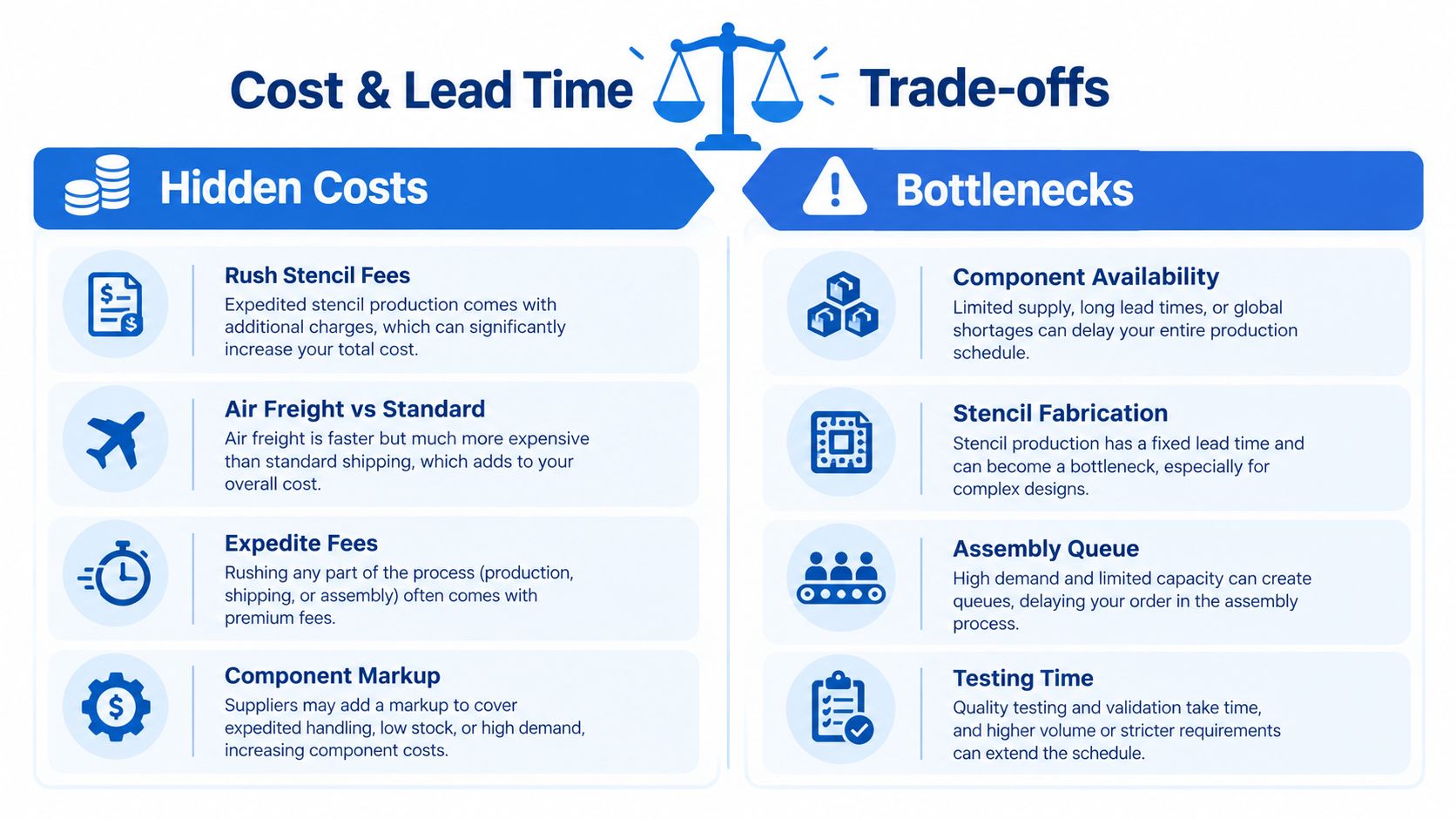
Read the quote by asking what drives elapsed time, then match spending to that constraint:
- Stencil and setup: Paying for priority tooling helps only if tooling is delaying production.
- Component purchasing: Small-quantity sourcing may carry different costs from purchasing full reels. Ask how the supplier handles excess parts.
- Freight: Compare expedited air shipping with standard service through carriers such as DHL, UPS, or FedEx. Freight changes transit time, not component availability or assembly readiness.
- Engineering changes: A post-review footprint or BOM change can require updated data, replacement materials, or new tooling.
- Testing and rework: Cutting a test step may make a quote look lean, but a defect found after shipment can create another build cycle.
<a id="compare-total-iteration-cost"></a>
Compare total iteration cost
A useful decision metric is total iteration cost, not assembly hours alone. Consider the likelihood of a redesign, the amount of surplus material, the freight mode, the testing needed to validate the prototype, and how unused components or boards will be handled. A slightly slower first build can be the better choice if it reduces the chance of an avoidable respin.
That calculation also includes environmental consequences. PCB production is reported to account for roughly 30% of electronics-sector CO₂ emissions, and less than 20% of global e-waste is properly recycled, according to sustainability coverage citing research (electronics manufacturing sustainability report). These figures don't tell you the footprint of a particular prototype, but they reinforce why unnecessary builds and poorly planned excess materials deserve attention.
Before approving an expedite charge, ask the supplier to identify the critical path. If the primary blocker is an unverified part, spend effort resolving sourcing and approval. If it's a production queue, a priority slot may help. The quote is most useful when it shows which cost changes the schedule and which merely changes the invoice.
<iframe width="100%" style="aspect-ratio: 16 / 9;" src="https://www.youtube.com/embed/cHGpMrYQNMA" frameborder="0" allow="autoplay; encrypted-media" allowfullscreen></iframe><a id="inspection-testing-and-certifications-that-matter"></a>
Inspection, Testing, and Certifications That Matter
Inspection methods answer different questions. Solder paste inspection (SPI) checks deposited paste before placement. Automated optical inspection (AOI) examines visible component position, polarity, and solder features. Neither can directly verify every joint hidden beneath a package.
For BGA and leadless components, ask whether X-ray inspection is appropriate to the package and defect risks. NIST's work on information management in board fabrication and assembly highlights the need for timely coordination between manufacturing stages, while IPC soldering guidance recognizes X-ray as an inspection method for conditions that can't be assessed by other means (NIST publication on board fabrication and assembly information gaps). Flying-probe testing can check electrical connections without dedicated production fixtures, and functional testing verifies whether the board performs its intended job under the agreed test conditions.
<a id="match-the-control-to-the-product"></a>
Match the control to the product
A product with hidden joints, fine-pitch parts, or safety-critical functions may need a different inspection plan from a simple board intended for early bench evaluation. Specify the acceptance criteria and required records in the purchase order. Don't assume that “tested” means the same thing to the supplier and the customer.
Certifications also have distinct purposes. ISO 9001 concerns quality management, ISO 13485 is associated with medical-device quality systems, IATF 16949 applies to automotive quality management, UL relates to product-safety requirements, and RoHS addresses restrictions on certain substances. A logo on a website doesn't replace confirming the scope and current status relevant to your build. Review the supplier's certification information and ask which controls apply to the work being quoted.
<a id="turnkey-versus-consignment-and-how-to-decide"></a>
Turnkey Versus Consignment and How to Decide
With turnkey assembly, the supplier sources components as well as managing assembly. With consignment, the customer supplies the parts, typically as a kit. Neither model is automatically faster. The schedule depends on whether the required components are available, correctly identified, and ready when the production slot opens.
Turnkey can simplify coordination when the customer needs small quantities or has not secured every part. It also makes supplier records central to component traceability, so request manufacturer documentation, authorized-source records, and lot or date-code details. Consignment can give a customer tighter control over known inventory and lots, but an incomplete kit, damaged packaging, or quantity mismatch can stall the build.
<a id="make-the-decision-from-evidence"></a>
Make the decision from evidence
Functional testing verifies electrical behavior. It doesn't establish that a component is authentic. When speed pushes sourcing toward brokers or fragmented channels, ask what records support authenticity and what the supplier will do if a suspect part is discovered after shipment. Incoming inspection and traceable purchasing records matter because they help connect a component lot to the boards built with it.
Use turnkey when sourcing coordination is the main obstacle and the supplier can document the chain of custody. Choose consignment when you already hold suitable stock from sources you trust and need direct control of the lots. In either case, agree on substitutes before the assembler places an order.
- Choose turnkey when the supplier can source the required parts with records you can review.
- Choose consignment when your own inventory is complete, verified, and ready to ship.
- Pause before release if provenance, alternate approval, or lot identification is unresolved.
For a closer look at the sourcing model, review the turnkey PCB assembly service, then ask the supplier to confirm component sources, traceability documents, and substitution approval in the quote. That evidence is part of the build plan, not an administrative extra.
Lianyuhong Technology Co.,Ltd provides quick-turn PCB fabrication and SMT and THT assembly, with turnkey sourcing, engineering review, and inspection options for prototypes and low-volume builds. Share your revision-controlled files, BOM, and required delivery window with Lianyuhong Technology Co.,Ltd to discuss a practical assembly schedule.