
Your prototype board passes every bench check. Then someone screws it into the enclosure, folds the harness around a bracket, closes the lid, and the unit stops communicating. You're no longer troubleshooting just a circuit board. You're troubleshooting the interaction between electronics, wiring, mechanical parts, firmware, and the assembly method.
That's the problem box build assembly services should solve. For a founder or procurement lead, the important question isn't whether a supplier can put boards into boxes. It's whether that supplier can deliver a working system, prove what was built and tested, and provide the records needed to support it after shipment.
Table of Contents
- What Box Build Assembly Services Include
- How a Box Build Project Moves From Files to Shipment
- Quality Standards, Testing and Traceability Requirements
- What Drives Box Build Cost and Which Model Fits
- Use Cases for IoT, Industrial, LED and Power Builds
- Vendor Selection Checklist for Box Build Partners
- Confirm Your Box Build Scope Before You Request Quotes
<a id="what-box-build-assembly-services-include"></a>
What Box Build Assembly Services Include
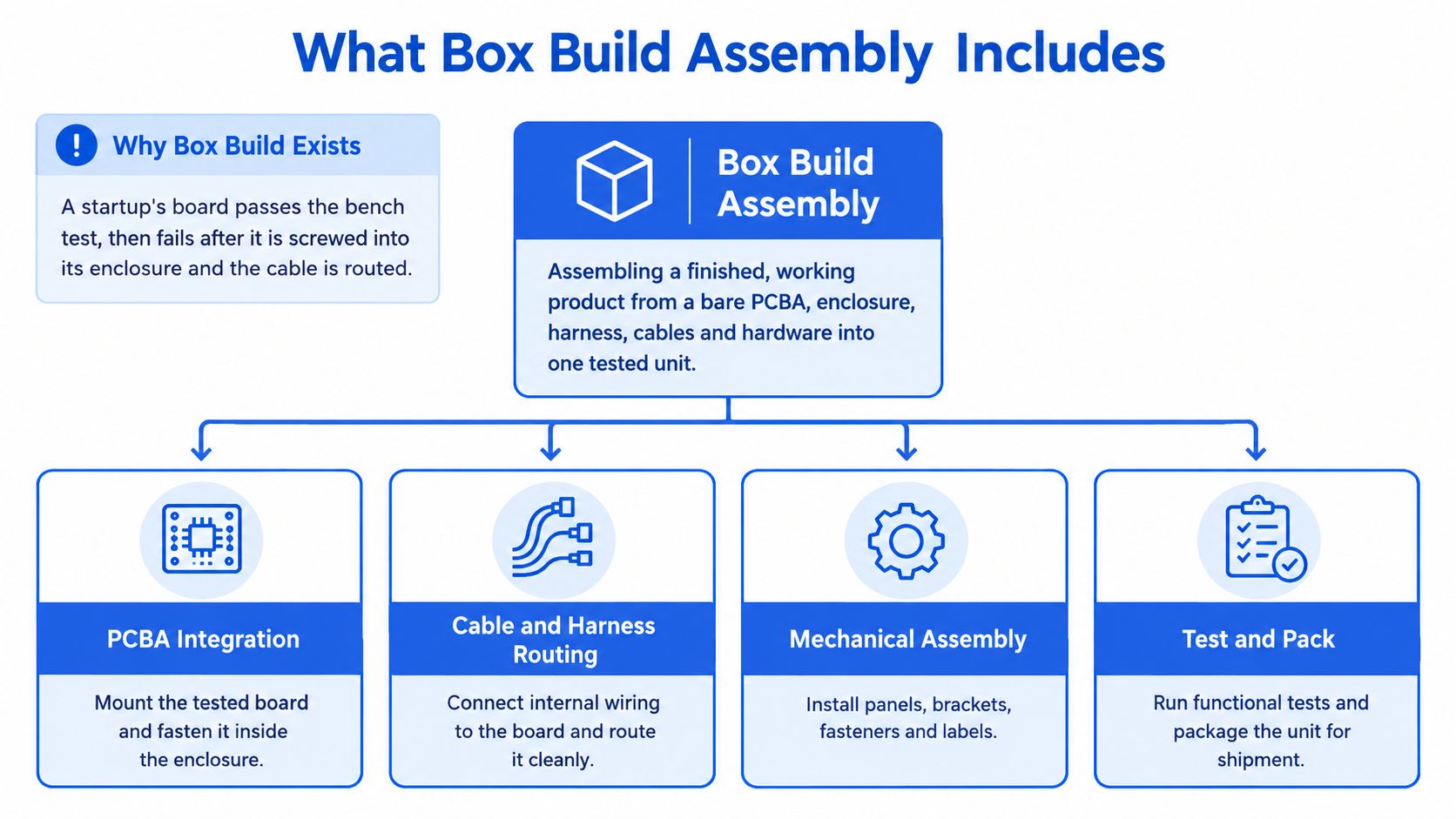
Box build assembly combines populated circuit boards, enclosures, cables, harnesses, mechanical hardware, and software configuration into a complete functional unit. PCB assembly builds the engine. Box build builds the car, and the integration provider should be accountable for the car running against an agreed acceptance specification.
That distinction matters when a board works outside its housing but fails after installation. A misplaced standoff can stress the PCB, a panel can trap a wire, or a harness can pull against a connector. None of those problems is solved by inspecting solder joints more closely.
The assembly scope runs from board installation through shipment preparation.
<a id="define-the-deliverable-not-just-the-activity"></a>
Define the deliverable, not just the activity
Box build scope elements and deliverables
| Scope element | What the provider does | Deliverable to request | |---|---|---| | Enclosure integration | Mounts boards, panels, heatsinks and brackets into the chassis | Torque and fastener log with build traveler | | Wiring and cable harnesses | Builds, routes and terminates cables and harnesses | Wire, crimp and continuity records | | Subassembly | Builds sub-units such as power modules or sensor heads and tests them before final build | Subassembly test report | | Final test | Powers the unit and runs functional and electrical checks | Serial-numbered test record | | Labeling and packaging | Applies approved serial and regulatory labels, loads firmware, kits and packs for shipping | Pack list and label files |
The standards basis extends beyond board-level workmanship. IPC-A-630, first issued in September 2013, covers electronic box assemblies, including enclosure fabrication, printed-board installation, cable and harness integration, interconnection, marking, labeling, and final testing, according to IPC's standards information.
That scope brings electronics assembly, mechanical fabrication, wiring, thermal management, and system verification into the same deliverable. It doesn't mean every supplier performs every operation internally. Enclosure fabrication might be subcontracted while integration happens at the electronics assembly site.
Practical rule: A service list says what a supplier can do. A scope statement says what the supplier owes you.
Hardware startups need a first complete unit that works without an engineer standing beside it. OEM procurement teams need a clear owner for the finished product. Both should specify responsibility for interfaces, not just individual parts.
<a id="how-a-box-build-project-moves-from-files-to-shipment"></a>
How a Box Build Project Moves From Files to Shipment
A reliable schedule starts with a released manufacturing package, not an email containing unrelated drawing revisions. Give the provider a document index identifying the approved version of each file and name the person authorized to approve changes.
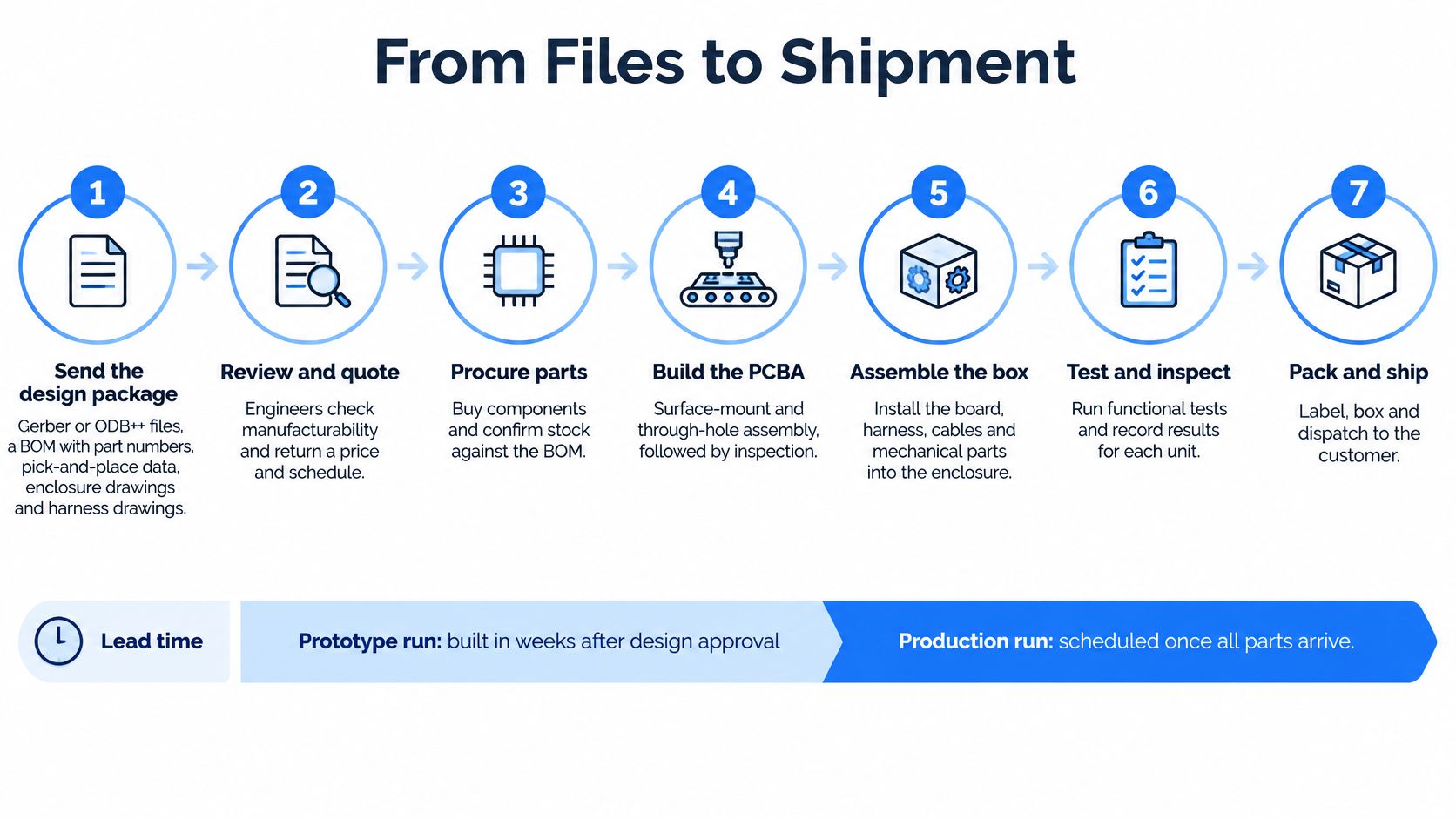
The workflow below shows the major handoffs. Treat each handoff as an approval point rather than assuming that uploading files authorizes purchasing or production.
<a id="release-the-build-in-controlled-steps"></a>
Release the build in controlled steps
- Send the design package. Include Gerber or ODB++ files, the BOM with manufacturer part numbers, pick-and-place data, enclosure drawings, and harness diagrams. Add assembly drawings showing hardware orientation and cable routing.
- Resolve DFM and BOM findings. Review mechanical access, connector fit, component availability, and proposed substitutions before purchasing. A substitute that fits the PCB may still interfere with the enclosure.
- Approve the quote and test plan. Confirm the engagement model, exclusions, acceptance criteria, fixture ownership, and required shipment records. Don't leave functional testing as an undefined line item.
- Procure and build subassemblies. Release board fabrication, component purchasing, and approved mechanical or harness work in parallel where practical. Track dependencies so an unfinished cable doesn't strand completed electronics.
- Integrate the enclosure. Install boards and hardware, route and terminate harnesses, and apply the approved identification. Record deviations rather than letting operators improvise undocumented fixes.
- Complete the traveler. Verify that incoming, subassembly, and system acceptance operations are complete. Hold units with unresolved nonconformances instead of treating shipment inspection as permission to bypass them.
- Pack and release. Reconcile unit identities, accessories, packaging, and documentation. Deliver the agreed records with the shipment.
At Lianyuhong Technology Co.,Ltd, our turnkey PCB assembly process follows file upload, BOM review and quotation, approval, production, inspection, and worldwide shipment via DHL, UPS, or FedEx. After quote approval, we procure components, fabricate boards, and begin assembly.
<a id="separate-pcb-assembly-timing-from-box-build-timing"></a>
Separate PCB assembly timing from box build timing
The durations below describe our turnkey PCB assembly service, not an unconditional promise for a finished enclosure-and-harness build.
Typical box build lead times by build stage
| Build stage | Typical duration | What moves the schedule | |---|---|---| | Prototype turnkey build | Our PCB assembly can ship in 24 hours if parts are in stock; standard builds take 2 to 5 business days | Component availability, board complexity, and additional integration scope | | Volume production | Our PCB assembly typically takes 7 to 15 business days | Component availability and board complexity after quote approval | | Consigned full-kit build | Schedule established after kit-completeness check | Whether the customer's kit is complete and matches the BOM |
Use this video alongside the written manufacturing sequence, not as a substitute for an approved traveler.
<iframe width="100%" style="aspect-ratio: 16 / 9;" src="https://www.youtube.com/embed/vD6ldpRJtXw" frameborder="0" allow="autoplay; encrypted-media" allowfullscreen></iframe>For a complete box build, component availability, enclosure readiness, harness fabrication, and test-fixture readiness can set the critical path. Paying to accelerate assembly labor won't help if the mating connector hasn't arrived.
<a id="quality-standards-testing-and-traceability-requirements"></a>
Quality Standards, Testing and Traceability Requirements
A workmanship class belongs in the purchase specification before production is approved, not after the first field failure. General-function products, products requiring extended service life, and high-performance products that cannot tolerate downtime each carry different acceptance expectations. Name the applicable class and governing documents in the specification rather than requesting unspecified IPC quality.
For harnesses, define the applicable IPC/WHMA-A-620 requirements alongside the electronic assembly requirements of IPC-A-610 and J-STD-001. NASA's workmanship guidance emphasizes approved engineering documentation and controlled harness workmanship, including a single governing harness standard for an individual mission-hardware build.
Translate that discipline into instructions an operator can follow: connector part numbers and keying, wire gauge, insulation type, crimp tooling, pull-test requirements, bend radii, torque values, and inspection checkpoints. Review our certification information separately from the product-specific acceptance plan. For regulated medical builds we assemble under an ISO 13485 quality system, but a quality-system certificate still does not define the limits for your particular unit.
<a id="test-after-installation-not-only-before-it"></a>
Test after installation, not only before it
A passing PCBA doesn't establish that the installed system is sound. Routing and fastening can damage insulation, unseat terminals, or create connections that fail only when the lid closes. Board-level inspection catches assembly defects; integration creates a new failure surface that only post-installation testing reaches.
NASA's harness-testing lessons learned identifies continuity-and-shorts testing and insulation-resistance testing as common checks, with post-installation dielectric-withstand testing required where the governing standard and tailoring call for it.
Test gates and what each one catches
| Test gate | Defect it catches | Typical checks | |---|---|---| | Incoming verification | Wrong, damaged or mislabeled cables and components | Connector keying, wire gauge, lot code check | | Subassembly electrical test | Opens and shorts inside harnesses before installation | Net-by-net continuity, short detection, insulation resistance | | Post-installation test | Damage from routing, fastening or enclosure installation | Continuity and shorts, insulation resistance, dielectric withstand where required | | Final system test | Faults across the complete unit | Polarity, protective-earth continuity, functional load test | | Serialized record | Trend and field-return analysis gaps | Measured values stored against serial number, operator and tooling |
Specify test limits, not just test names. Insulation and dielectric tests need approved voltages, pass/fail limits, sequencing, and equipment suitability; sensitive electronics may require isolation during testing. Safety-related procedures also need controlled operator authorization and calibrated equipment. A test name on a quote, without limits behind it, is a marketing line rather than a quality gate.
<a id="make-traceability-useful-during-a-recall"></a>
Make traceability useful during a recall
Each finished serial number should connect to relevant component and cable lots, firmware version, programming record, inspection results, test measurements, and shipment identity. Capture operator and tooling information where it supports containment or process investigation.
IPC-1782, IPC's electronics traceability standard, scales data collection to risk and product criticality across materials, components, and processes. That is a better purchasing principle than demanding indiscriminate data collection. On consigned builds we keep assembly records even though you supply the parts, and under partial turnkey we hold full records for the items we source.
A searchable record that identifies affected units is more useful than a large archive nobody can reconcile.
Agree on retention period, export format, substitution approvals, and split-lot handling. When a drop-in replacement is approved for a scarce or end-of-life part, that substitution should be logged against the affected serials. Then run a mock recall before you need a real one: pick a suspect cable lot and require the provider to identify the affected finished units and their shipments within a set time.
<a id="what-drives-box-build-cost-and-which-model-fits"></a>
What Drives Box Build Cost and Which Model Fits
Why can quotes for the same product look so different? Often, the suppliers haven't priced the same deliverable. One includes a functional fixture, harness testing, and serialized records; another includes assembly labor and a visual check.
Compare the cost structure before negotiating the total. Removing a test line can lower the purchase price while leaving your engineering team responsible for finding integration faults.
Cost drivers and how each one moves the quote
| Cost driver | How it moves the quote | Question to ask | |---|---|---| | Custom enclosure and fixtures | Adds tooling, setup and fixture cost | Which fixtures are one-time and which are reusable? | | Harness complexity | More connectors, lengths and test points add labor and test time | How is harness test time priced? | | Test depth | Functional and dielectric tests add fixture and cycle time | Which tests are included in the base price? | | Scarce or end-of-life parts | Raises material cost and lead-time risk | Are substitutes proposed before purchase? | | Order volume | Spreads setup cost across more units | What is the price break at my volume? | | Inventory model | Turnkey carries procurement cost; consigned shifts shortage risk to buyer | Who holds inventory and who owns shortage risk? |
<a id="choose-who-manages-materials"></a>
Choose who manages materials
We offer full turnkey, consigned full-kit, and partial turnkey assembly. In our full-turnkey model, we source components and hold component inventory. That reduces the customer's purchasing workload, but procurement effort and material management remain part of the commercial offer.
Under consigned full-kit assembly, the customer supplies the boards and components and holds inventory. We provide SMT and through-hole assembly and retain assembly records. The quoted service price excludes customer-supplied materials, so it shouldn't be compared directly with a material-inclusive turnkey total.
With partial turnkey, we fabricate boards and source hard-to-find components while the customer supplies the remaining components. Inventory risk is shared, and we maintain full records for the items we source.
For a small launch, low-volume PCB assembly can support controlled production while you stabilize the design. Keep reusable fixture costs separate from recurring unit costs so a later order doesn't become a fresh negotiation over the same tooling.
Quote comparison: Put materials, setup, fixtures, assembly, testing, records, packaging, and freight on separate lines.
Also define ownership of excess material, unusable consigned parts, and engineering changes after purchasing. Those responsibilities matter more than a small difference in assembly labor.
<a id="use-cases-for-iot-industrial-led-and-power-builds"></a>
Use Cases for IoT, Industrial, LED and Power Builds
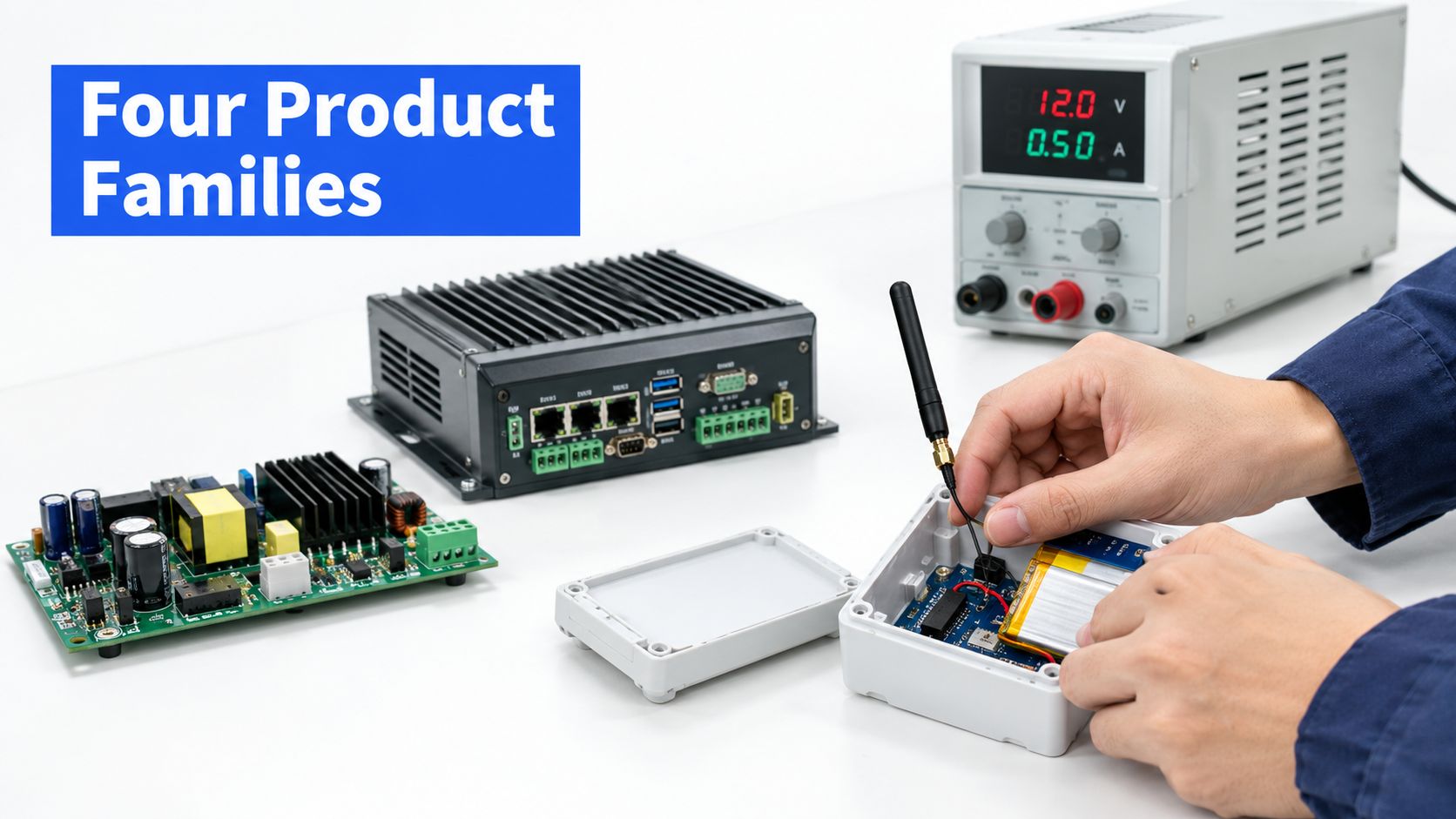
The right assembly plan follows the product's likely failure points. A sealed wireless sensor and a power converter may both arrive in enclosures, but their integration and verification priorities are different.
The physical work includes electrical connections, mechanical fit, and the placement of parts that affect cooling or communication.
<a id="match-the-checks-to-the-product"></a>
Match the checks to the product
Say you're building an IoT gateway with a radio module, antenna, and backup battery. Test communication with the final lid fitted, not with the antenna exposed on the bench. Control antenna placement relative to metalwork and battery wiring, and inspect gasket seating before applying the product's specified seal test.
An industrial controller adds a DIN-rail housing, power supply, and I/O harness. Give technicians connector-locking instructions and a routing drawing that separates sensitive signals from noisy power wiring. Exercise the actual inputs and outputs; a successful boot screen doesn't prove that a mislabeled harness reaches the correct terminal.
For an LED luminaire, inspect the thermal interface before it disappears under the board or heatsink. Specify material placement and fastening sequence, then evaluate temperature under representative operating conditions. A lamp that lights briefly can still have an unacceptable heat path.
Box build content and main risk by product family
| Product family | Typical box build content | Main risk | |---|---|---| | IoT sensor node or gateway | RF module, antenna, battery, sealed enclosure | Antenna detuning from enclosure placement and seal failure | | Industrial controller | DIN-rail enclosure, power supply, I/O harness, connectors | Connector loosening under vibration and wiring errors | | LED luminaire | Metal-core or ceramic board, heatsink, thermal interface material, optics | Thermal hotspots from poor heat path | | Power conversion unit | Busbars, high-voltage harness, cooling, insulated enclosure | Insulation damage and failed dielectric test | | Medical or regulated device | Sealed enclosure, traceable harness, controlled test records | Missing lot and serial traceability |
A power conversion unit needs particular attention to busbar installation, protective bonding, cooling, and insulation barriers. Inspect creepage and clearance against the approved design, including displaced wires and fasteners, before running the specified electrical safety tests.
For a medical or regulated device, apply the product's documented environmental and configuration requirements. Don't assume every medical product needs a sealed enclosure, but where sealing is specified, the assembly and service methods must preserve it.
<a id="vendor-selection-checklist-for-box-build-partners"></a>
Vendor Selection Checklist for Box Build Partners
A convincing factory presentation isn't enough. Give every candidate the same questions and require evidence tied to the proposed build site, equipment, subcontractors, and deliverables.
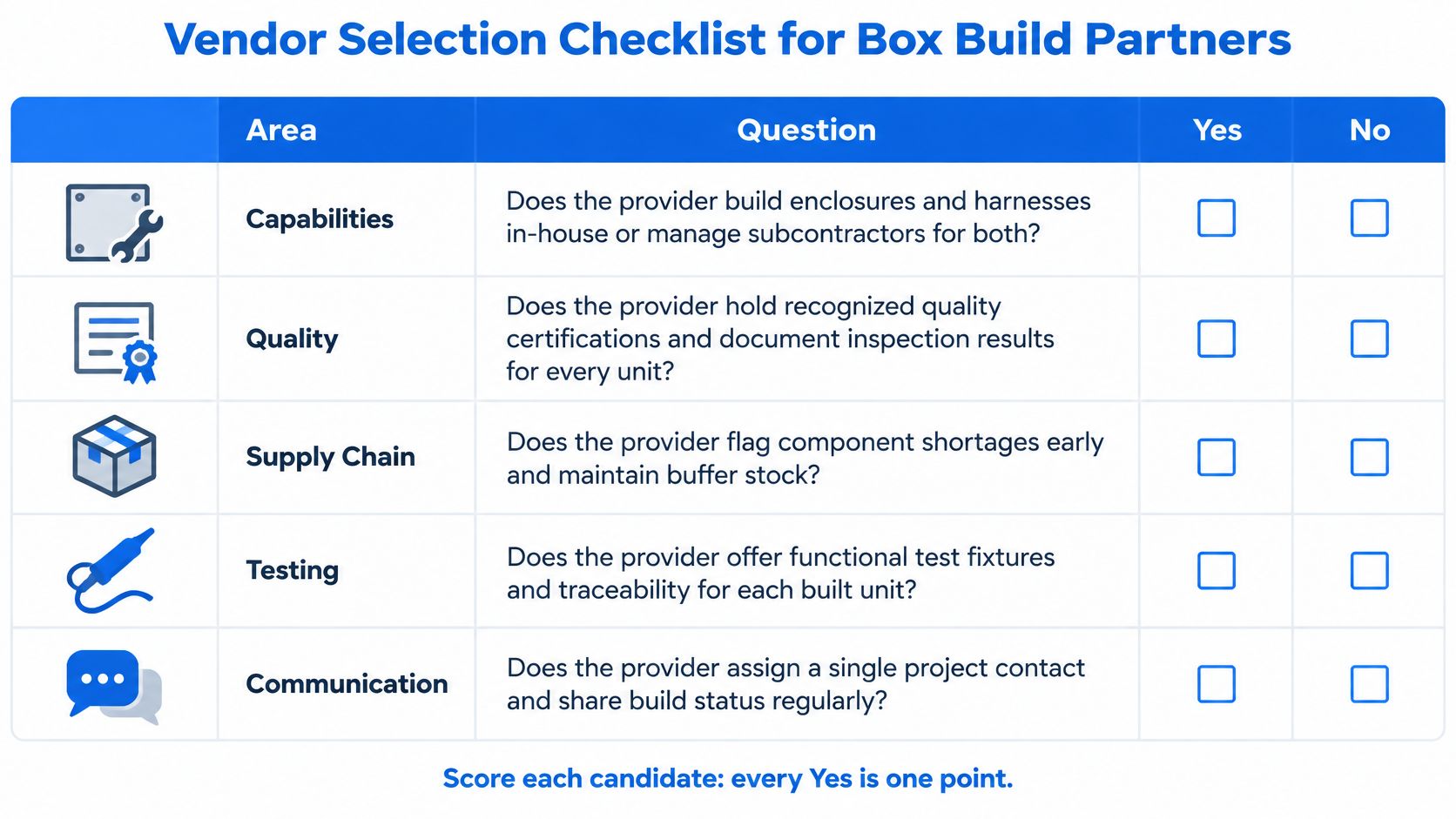
Use this checklist to organize the discussion, then investigate any answer that relies on an unnamed partner or an undefined inspection process.
<a id="require-evidence-behind-each-yes"></a>
Require evidence behind each yes
- Capabilities. Does the proposed team cover your enclosure, harness, board technology, and component pitch? Require a responsibility map identifying in-house work, subcontracted work, and who approves the subcontractor's output.
- Quality system. Does the certificate cover the site and activity performing your build? Evaluate ISO 9001 for general quality management, ISO 13485 for applicable medical requirements, and IATF 16949 where automotive customer requirements call for it. Don't treat these certificates as interchangeable product approvals.
- Testing. Can the provider show how inspection findings and functional results connect to a released unit? Request a redacted example record and clarify how retests, failures, and repairs remain visible.
- Supply chain. Can the provider document authorized-distributor sourcing, lot identity, and handling of small component quantities? Our sourcing supports authorized distributors, traceable lot records, and cut-tape quantities.
- DFM and BOM review. Will purchasing wait for approval of proposed changes? During our BOM review, we flag scarce or end-of-life parts and suggest drop-in replacements before purchase authorization. Customers can supply obsolete parts without direct substitutes under partial turnkey.
<a id="distinguish-board-capability-from-system-capability"></a>
Distinguish board capability from system capability
Our turnkey PCB assembly services combine board fabrication, sourcing, SMT, through-hole, and mixed assembly under one quality system. We perform SPI, AOI, and X-ray inspection on every build and offer flying-probe and functional testing.
Those capabilities establish the electronics assembly scope. They don't establish an enclosure fabrication, harness manufacturing, or finished-system safety-test commitment. Confirm those items in writing before treating a PCB assembly quotation as a box build quotation.
Red flags include a quote that omits mechanical integration, a certificate that doesn't identify the manufacturing site, and a test report containing only an unexplained pass mark. Also challenge suppliers who cannot explain how they control approved deviations.
Choose a project contact who can obtain engineering decisions, not just relay shipping updates. Require written approval before the provider changes materials, routing, firmware, or a test limit.
<a id="confirm-your-box-build-scope-before-you-request-quotes"></a>
Confirm Your Box Build Scope Before You Request Quotes
Prepare a package that lets candidates quote the same finished product. We accept Gerber RS-274X, ODB++, and IPC-2581 formats; include the BOM with manufacturer part numbers and pick-and-place data for the electronics, plus the mechanical and harness documents needed for integration.
Keep the procurement decisions short and explicit:
- Release the product definition. Supply approved drawings, assembly notes, and a written test plan naming the required acceptance gates.
- Choose the commercial boundary. Identify turnkey, consigned full-kit, or partial-turnkey responsibilities, including customer-supplied items.
- Specify the evidence package. Define serialization, required records, file formats, ownership, and delivery method.
- Set the urgency. We offer 24-hour expedited turnkey assembly for urgent iterations. Reserve it for work that needs acceleration, with material readiness and any additional box build operations confirmed separately.
<a id="request-service-ready-delivery"></a>
Request service-ready delivery
A shipped unit also needs a support plan. Request repair instructions, approved replacement parts, firmware history, and a method for recording field configuration changes.
The electronica overview of EU Digital Product Passports and repair rules states that the Right-to-Repair Directive must be transposed by July 31, 2026, and describes progressively introduced product-passport requirements rather than a universal obligation for every electronic product. Check the measures applicable to your product and market instead of assuming one compliance deadline covers everything.
Ask who owns the lifecycle data and who maintains it after a manufacturing change. Review whether fasteners, adhesives, batteries, and mixed materials permit safe, non-destructive servicing.
Assembly-complete delivery ends with an accepted unit. Service-ready delivery adds the information and access needed to maintain that unit without losing configuration control.
This week, send your released package for DFM and BOM review. Compare returned quotes by materials, tooling, integration, testing, documentation, and service deliverables, not just the final total.
Lianyuhong Technology Co.,Ltd offers PCB fabrication, turnkey SMT and through-hole assembly, component sourcing, and engineering DFM and BOM review. Visit Lianyuhong Technology Co.,Ltd to submit your manufacturing package, request a detailed quotation, and confirm the enclosure, harness, testing, and records scope needed for your box build.