
Turnkey PCB assembly is a service where one supplier handles everything from component sourcing and board fabrication to assembly, testing, and delivery, so the buyer receives a finished, tested board rather than coordinating multiple vendors. It works best when the supplier's sourcing controls, inspection plan, and quality requirements are specified as carefully as the board itself.
You may be trying to release a prototype while a fabricator waits for an updated drawing, a distributor flags a component shortage, and an assembly house asks when the parts will arrive. Each handoff creates another schedule to track and another place for a revision or quality issue to slip through. A turnkey partner can bring those activities under one point of coordination, but that convenience doesn't remove the need to check what happens behind the scenes.
Table of Contents
- What Turnkey PCB Assembly Services Mean for Your Project
- How Turnkey Assembly Differs from Consignment and Partial Models
- The End-to-End Turnkey Assembly Process
- Key Benefits and Risks Buyers Should Weigh
- How to Evaluate and Select a Turnkey Assembly Partner
- What Lianyuhong Brings to Turnkey Assembly
- Frequently Asked Questions About Turnkey PCB Assembly
<a id="what-turnkey-pcb-assembly-services-mean-for-your-project"></a>
What Turnkey PCB Assembly Services Mean for Your Project
Turnkey PCB assembly services put procurement, fabrication, assembly, inspection, testing, and delivery into a coordinated supply arrangement. Instead of managing separate suppliers for bare boards, components, assembly, and shipping, your team provides the manufacturing package and agrees with one provider on who owns each production step.
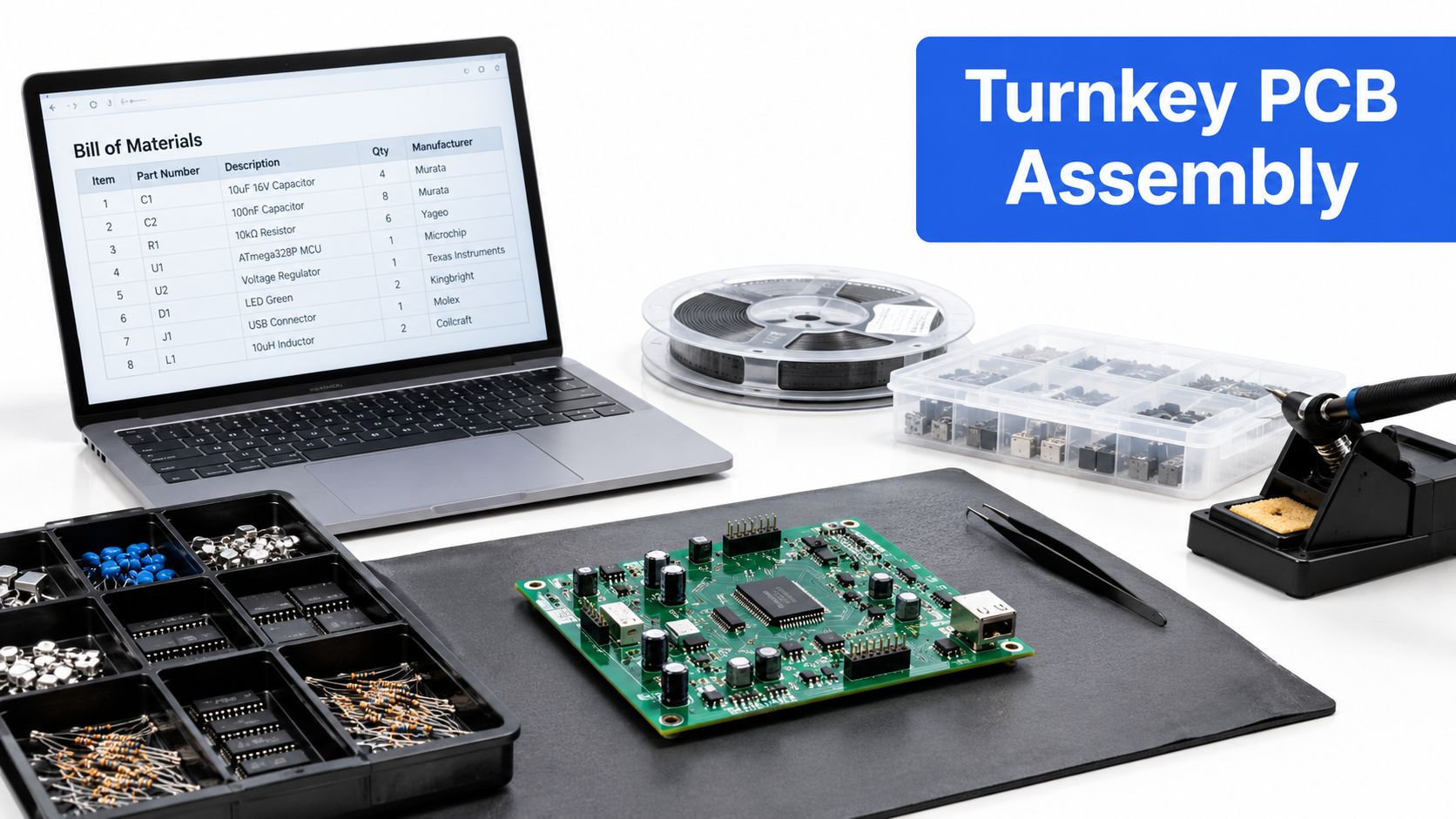
That consolidated responsibility can help a small hardware team focus on design and validation rather than chasing part deliveries and reconciling supplier updates. It's useful for an early prototype, a low-volume build, or recurring production, provided the manufacturer can support the board's technical requirements and the buyer remains clear about acceptance criteria.
Turnkey shouldn't be treated as a single purchase order for convenience. It's an integrated quality and supply-chain system. IPC's benchmark research covered 118 electronics assembly companies and PCB fabricators worldwide, with observations describing the industry in 2016 and forecasts extending to 2021. The benchmarking program tracked manufacturing measures such as yields, defect rates, inspection and test methods, supplier performance, customer returns, and certification. That provides a practical lens for evaluating a supplier: ask for evidence about its processes and results, not only placement speed or a general claim of quality. (IPC's electronics industry benchmark research)
For example, a prototype quote should clarify who checks the bill of materials (BOM), who approves substitute parts, what inspection is included, and whether functional testing is available. For repeat builds, add questions about lot traceability, revision control, nonconformance handling, and delivery performance. A single supplier can simplify accountability, but only a well-defined scope makes it clear what that accountability covers.
Practical rule: If the quote says “turnkey” but doesn't explain sourcing, inspection, and test responsibilities, ask for the missing detail before approving production.
<a id="how-turnkey-assembly-differs-from-consignment-and-partial-models"></a>
How Turnkey Assembly Differs from Consignment and Partial Models
The core difference between turnkey, consignment, and partial-turnkey assembly is who buys the components and manages the associated risks. In full turnkey, the supplier coordinates the full manufacturing chain. In consignment, the customer provides all components for the assembler to build. Partial turnkey splits the work: the customer supplies selected parts, and the supplier sources the rest.
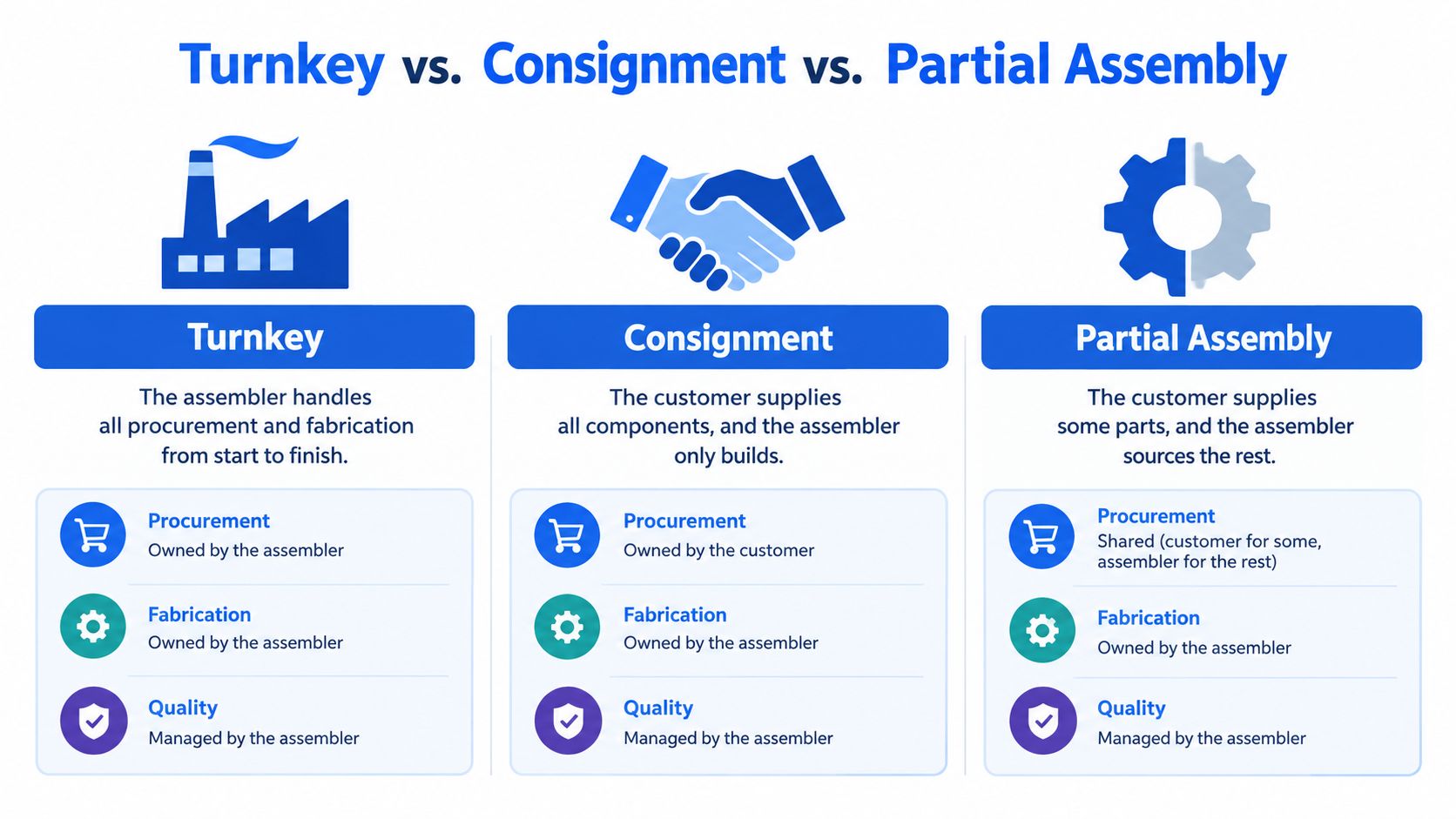
| Model | Component purchasing | What the buyer keeps control of | What needs close coordination | |---|---|---|---| | Turnkey | Supplier sources the BOM and may coordinate PCB fabrication, assembly, and delivery. | Requirements, approved parts, substitutions, quality criteria, and design revisions. | Sourcing evidence, traceability, quote transparency, and supplier change approval. | | Consignment | Customer supplies all components; the assembler builds the boards. | Distributor choice, purchasing decisions, and inventory ownership. | Part condition, delivery timing, quantities, and compatibility with the assembly plan. | | Partial turnkey | Customer supplies selected parts; supplier procures the balance. | Critical, proprietary, or customer-controlled components. | Clear responsibility for each BOM line, including receipt checks and shortage response. |
Consignment may suit a buyer with established purchasing channels, owned inventory, or parts that must come from a specified source. The trade-off is that the customer also manages packing, shipment, availability, and timing for those parts. Partial turnkey can preserve control over selected components while handing routine purchasing to the manufacturer. It works only when both parties agree in writing which components each one owns.
Global manufacturing conditions help explain why integrated arrangements matter. IPC reporting describes U.S. PCB production as just over $11 billion before the Asian shift of 2000–2001, compared with just over $3.5 billion currently, and says North American fabricators fell from approximately 1,500 in the 1990s to fewer than 200 today. A separate IPC summary puts PCB manufacturing at about 2% of the global market by 2023. Those figures describe a structural shift toward Asian manufacturing ecosystems, making international sourcing and logistics considerations relevant for many buyers. (IPC's summary of PCB fabrication capacity)
That global reach doesn't mean turnkey automatically reduces risk. It changes where the buyer needs visibility. Ask who can approve alternates, which sources are permitted, and how component lots are linked to finished boards. If your team is weighing small-run options, this guide to low-volume PCB assembly can help frame the production model around your actual volume and procurement needs.
<a id="the-end-to-end-turnkey-assembly-process"></a>
The End-to-End Turnkey Assembly Process
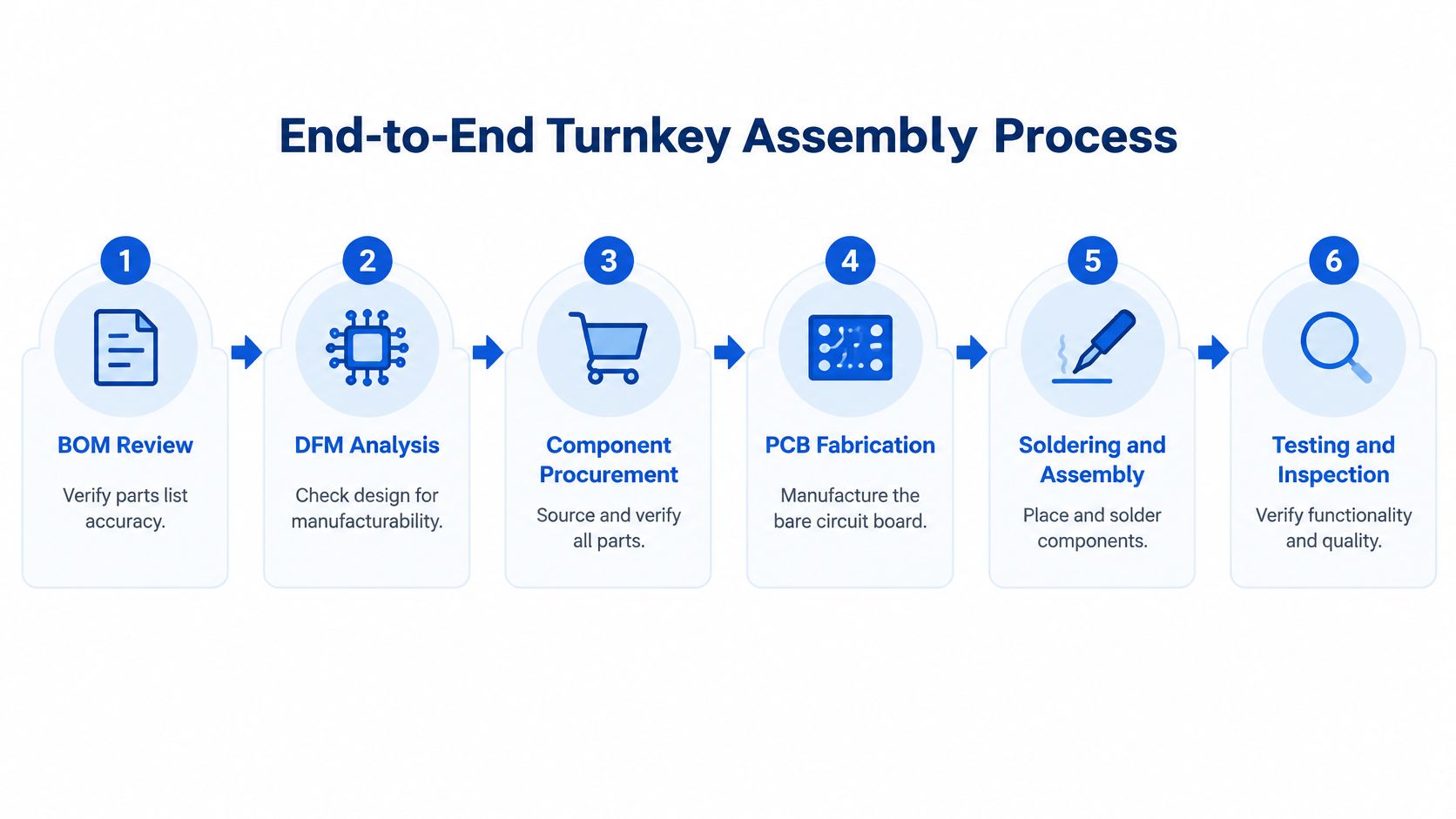
A complete turnkey build moves through defined stages, from checking your manufacturing files to packing finished boards. The sequence matters because early review and in-process inspection can catch problems before they become harder to correct.
<a id="start-with-the-bom-and-design-review"></a>
Start with the BOM and design review
The supplier checks the BOM against part numbers, quantities, package types, and assembly files, then reviews the board for manufacturability. A mismatch between a package footprint and a component, an incomplete placement file, or an unclear approved alternate can delay the build or lead to an incorrect assembly. Resolve questions before the quote becomes a production commitment.
<a id="source-components-and-fabricate-the-board"></a>
Source components and fabricate the board
For each BOM line, establish the approved source and what happens if the listed part is unavailable. The supplier may then procure components and coordinate bare-board fabrication to the supplied stack-up, material, finish, and other design requirements. The buyer should review any proposed substitution before it's purchased or installed, especially where a part's electrical, thermal, or regulatory characteristics matter.
<a id="print-paste-place-components-and-solder"></a>
Print paste, place components, and solder
For surface-mount assembly, solder paste is applied through a stencil, then components are placed on the paste and soldered in a reflow oven. Solder paste inspection (SPI) checks paste deposition before placement and reflow, allowing printing problems to be corrected before they become solder-joint defects. Through-hole parts may require separate insertion and soldering steps, depending on the design.
<a id="inspect-and-test-using-complementary-methods"></a>
Inspect and test using complementary methods
No single inspection method sees every failure mode. Automated optical inspection (AOI) checks visible placement and solder-joint features after reflow, but it can't fully inspect hidden connections under packages such as BGAs and bottom-terminated components. X-ray inspection can help evaluate internal joints and void-related conditions, while functional testing checks whether a board performs electrically against defined requirements. IPC's assembly checklist identifies SPI, AOI, X-ray-related practices, and reliability controls as complementary parts of inspection planning. (IPC's PCBA checklist)
Specify where these checks occur, what defects trigger review, and whether inspection is sampled or covers every board. Also agree on test fixtures, pass/fail criteria, and how results are associated with board serial numbers. A test without documented limits is difficult to interpret or reproduce.
Inspection should follow the defect: check paste before reflow, visible placement and joints after reflow, and hidden connections or electrical operation with appropriate methods before shipment.
The supplier completes the build by documenting results, protecting boards for shipment, and arranging delivery. If your project is at prototype stage, PCB prototype assembly offers a useful comparison for defining what you need from an early build.
<iframe width="100%" style="aspect-ratio: 16 / 9;" src="https://www.youtube.com/embed/YWsKJmgYYkk" frameborder="0" allow="autoplay; encrypted-media" allowfullscreen></iframe><a id="key-benefits-and-risks-buyers-should-weigh"></a>
Key Benefits and Risks Buyers Should Weigh
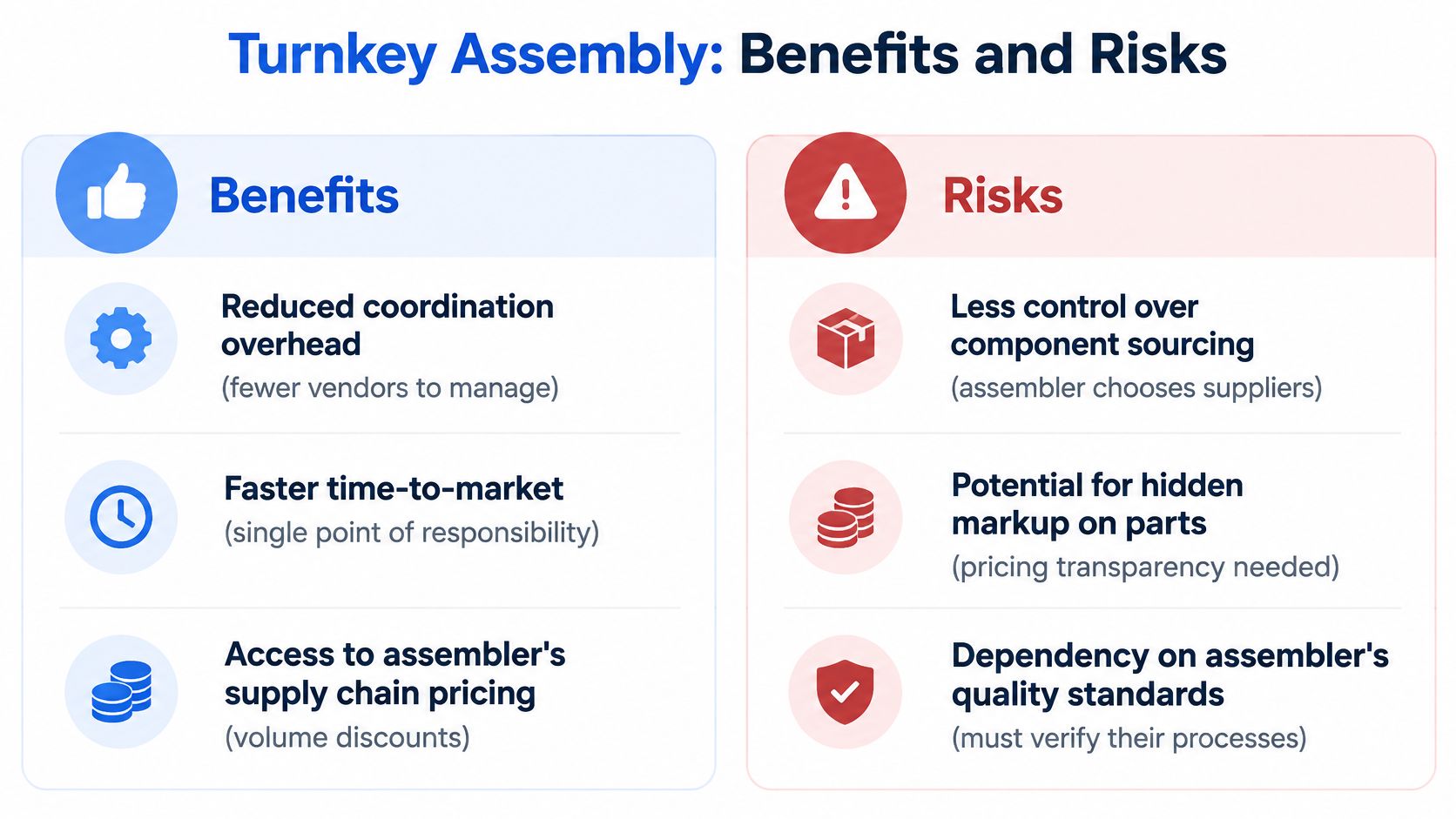
A turnkey arrangement reduces the number of separate supplier relationships a team has to coordinate. It can also give the assembler a clearer view of component availability, fabrication timing, and build readiness. Those advantages matter most when the manufacturer communicates exceptions early and accepts clear responsibility for resolving them.
The main risk is assuming that outsourcing procurement also outsources the buyer's need to verify it. If a shortage prompts a substitute, the buyer needs to know who authorized the change, what technical evidence supports it, and how the decision is recorded. Neutral 2025 guidance identifies brokers and independent distributors as higher-risk entry points for counterfeit material and recommends electronic traceability back to the original manufacturer rather than relying on paperwork alone. (2025 guidance on component traceability and risk)
Ask for records that connect the component source and lot to the assembled board. For moisture-sensitive components, clarify how storage and handling are documented. If a part comes through a broker or independent distributor, define whether the supplier must disclose that route and obtain your approval before purchase. A certificate of conformance can be useful, but it shouldn't be the only evidence of component authenticity.
Cybersecurity deserves the same attention as physical quality controls. Manufacturing workflows can involve BOMs, CAD files, firmware, test programs, portals, subcontractors, and connected factory systems. A manufacturing risk report describes electronics as facing critical cyber-risk levels and notes threats including data breaches, ransomware, phishing, and attacks through sub-tier suppliers. (Everstream's 2025 manufacturing risk report)
A compromised revision, altered BOM, or changed test limit can affect a physical product even if assembly workmanship looks acceptable. Ask how the supplier controls access, transfers files, manages revisions, separates customer data, responds to incidents, and controls subcontractor access. Also settle ownership and retention of production files. Turnkey is a transfer of operational work, not a reason to give up visibility.
<a id="how-to-evaluate-and-select-a-turnkey-assembly-partner"></a>
How to Evaluate and Select a Turnkey Assembly Partner
Assess a supplier by evidence, not by the number of services on its capability sheet. Before releasing production files, check whether its process, sourcing controls, and information-security practices match the product's requirements.
| Evaluation Area | Key Questions | Evidence to Request | |---|---|---| | Technical capability | Can the supplier build your board's component mix, package types, and technology? Does it review design and BOM issues before production? | Relevant equipment and process description, DFM findings, and a sample of the manufacturing documentation it produces. | | Quality requirements | What workmanship class applies, and how are acceptance criteria defined? Which inspection and test methods are used? | Purchase-order quality clauses, inspection plan, first-article records, test criteria, and nonconformance process. | | Component sourcing | Are components sourced through authorized channels? Who approves alternates, and how are broker-sourced parts handled? | Approved-source policy, purchase and lot records, substitution approval process, and traceability example. | | Cybersecurity | Who can access design files and production data? How are revisions, subcontractors, incidents, and data retention managed? | Access-control and file-transfer practices, revision-control procedure, incident-notification terms, and data-retention policy. | | Communication and delivery | Who owns issue resolution, and how are shortages or schedule changes escalated? | Named points of contact, quotation assumptions, status-report format, and shipment documentation. |
Don't write only “IPC compliant” on the purchase order. IPC-A-610 addresses visual acceptability of electronic assemblies, while IPC-J-STD-001 sets requirements for materials, methods, and acceptance criteria in soldered assemblies. State the applicable process class and identify solder alloy, flux family, component finish, cleanliness requirements, and inspection evidence. Class 3 is intended for applications where continued performance is critical, so the selected class should follow the product's reliability needs rather than a generic preference. (IPC-A-610 workmanship requirements)
NASA workmanship guidance reinforces that reliable interconnections depend on design features, materials, assembly processes, inspection methods, and defect criteria being controlled together. For a supplier comparison, use quick-turn PCB assembly as a prompt to separate a fast quote from a documented, technically suitable production plan.
Ask for the evidence before the order: a supplier's willingness to explain its controls is more useful than a broad compliance statement.
<a id="what-lianyuhong-brings-to-turnkey-assembly"></a>
What Lianyuhong Brings to Turnkey Assembly
A supplier's capabilities matter when they match the board and its risk profile. For a project that combines complex fabrication with assembly, one provider's ability to review the design, source components, build the bare board, and assemble it can simplify coordination. That doesn't replace supplier qualification; it gives the buyer a more consolidated process to evaluate.
Lianyuhong Technology's stated manufacturing range includes rigid boards, HDI with laser microvias, flexible and rigid-flex circuits, metal-core boards, high-frequency materials, and ceramic substrates. Its assembly scope covers SMT, through-hole, and mixed-technology builds, including fine-pitch and hidden-joint packages. Those options are relevant to teams whose design requirements extend beyond a standard rigid board, but buyers should still confirm that the quoted process, materials, and inspection plan fit their specific design.
The company lists SPI, AOI, X-ray, flying-probe, and functional testing among its process controls. These methods address different inspection and verification needs, so the practical question is how they'll be applied to your board: what will be inspected, when, and against which acceptance criteria? Request the proposed coverage and documentation before approving a production build.
For supply-chain review, the company states that it uses authorized-distributor sourcing and provides traceable lot records. Ask how that evidence links to assembly serial numbers and whether proposed substitutions require written customer approval. Its stated certifications include ISO 9001, ISO 13485, IATF 16949, UL, and RoHS compliance; verify that the relevant certificate or compliance evidence applies to the facility, product, and scope you're buying.
The company also describes quick-turn prototype assembly, small-batch production without a minimum order quantity, DFM and BOM review, and shipping through DHL, UPS, and FedEx. Treat lead time as order-specific: confirm material availability, review status, test requirements, and shipping assumptions in the quotation. The useful comparison is not whether a provider offers each service, but whether it can document the controls that matter for your build.
<a id="frequently-asked-questions-about-turnkey-pcb-assembly"></a>
Frequently Asked Questions About Turnkey PCB Assembly
<a id="how-long-does-a-turnkey-order-take"></a>
How long does a turnkey order take?
There isn't a reliable universal lead time. It depends on design readiness, board fabrication, component availability, assembly complexity, testing, and shipping. Ask the supplier to separate expected time for each stage and identify which unresolved BOM items could delay release.
<a id="what-drives-the-cost"></a>
What drives the cost?
The quote may include bare-board fabrication, component purchasing, assembly, inspection, testing, setup, packaging, and logistics. Request an itemized quote and ask how the supplier handles substitutions, customer-supplied parts, test fixtures, and design changes. Compare scope as well as total price.
<a id="how-can-i-check-quality-before-a-production-run"></a>
How can I check quality before a production run?
Start with a design and BOM review, agree on the workmanship class, and define inspection coverage and pass/fail criteria. Review a first article and its inspection records before approving repeat production. If the board has hidden joints or defined operating requirements, make sure the quote specifies the relevant X-ray or functional test plan.
<a id="what-documentation-should-arrive-with-each-shipment"></a>
What documentation should arrive with each shipment?
Agree on the package before production. Depending on the product, it may include inspection and test results, nonconformance records, applicable compliance documents, and component-lot traceability. Ask for the records to connect component lots with board serial numbers so you can investigate issues without relying on a supplier's general assurance.
Lianyuhong Technology Co.,Ltd offers PCB fabrication, turnkey SMT and through-hole assembly, component sourcing, and inspection and test options for prototype and production programs. If you're comparing turnkey PCB assembly services, share your BOM, fabrication files, and acceptance requirements with Lianyuhong Technology Co.,Ltd to discuss a quote and clarify the controls your build needs.