
Copper rose by about 120%, from approximately $4,371 per metric ton in March 2020 to $9,617 in February 2021, according to PCBOnline's analysis of PCB material costs. That historical jump exposes a weakness in circuit board price comparisons: an unchanged design doesn't guarantee an unchanged quote.
For procurement, the useful number isn't the factory price divided by the order quantity. It's the landed cost per working board, with material requirements, manufacturing yield, delivery obligations, and acceptance testing defined before suppliers quote.
Table of Contents
- Starting Prices for Each Board Type
- How Layer Count and Panel Size Change the Price
- Copper Weight and Special Materials That Raise Cost
- Quantity and Lead Time in the Final Price
- Landed Cost Including Shipping, Duties and Surcharges
- Why the Cheapest Quote Can Cost More
- Prepare Your Files and Request an Accurate Quote
<a id="starting-prices-for-each-board-type"></a>
Starting Prices for Each Board Type
| Board type | Starting price | Price basis | Typical use | |---|---|---|---| | FR-4 rigid PCB | From $2.00 | Per 5 pieces | Prototypes and general electronics | | High-frequency PCB | From $50.00 | Per 5 pieces | RF, microwave, and telecom boards | | Metal core PCB | From $25.00 | Per 5 pieces | LED lighting and power thermal management |
These are starting prices for the simplest eligible specifications at Lianyuhong Technology Co.,Ltd, not typical final quotes for complex designs. Our FR-4/HLC category starts at the listed entry price, but that doesn't mean a high-layer-count design qualifies for the minimum.
The table establishes a fabrication baseline, not a complete product budget. It doesn't establish the cost of components, assembly, international freight, or application-specific testing. Before comparing an advertised price with a production quotation, check whether both describe the same deliverable.
<a id="what-the-price-trend-actually-tells-you"></a>
What the price trend actually tells you
The Bureau of Labor Statistics bare printed-circuit-board producer-price series, indexed to December 2000 = 100, stood at 132.524 from September through December 2024 and reached 139.112 in December 2025, approximately 39.1% above the benchmark.
That index measures prices received by U.S. producers for bare boards. It isn't a retail quotation, a global price list, or a multiplier to apply directly to an overseas prototype offer. Its value is narrower: it gives buyers a consistent manufacturing-price benchmark over time.
A price increase therefore needs an explanation, not an automatic rejection. The supplier should distinguish a changed specification from a changed material cost or a different production allocation.
Buying baseline: Treat an entry price as an invitation to define the specification, not as a ceiling on the finished quote.
Use the table to identify the appropriate board family. Then establish layer count, copper distribution, substrate, order quantity, and delivery scope before assigning a realistic budget. Multiplying every advertised minimum by generic cost factors won't produce a reliable quotation because those factors interact.
<a id="how-layer-count-and-panel-size-change-the-price"></a>
How Layer Count and Panel Size Change the Price
The equal-area benchmarks below come from DFMA's PCB cost-estimating guidance: a four-layer board costs approximately 1.75 times a double-sided board, a six-layer board about 2.25 times, and an eight-layer board about 3 times.
| Layer count | Relative cost, equal area | Main reason it rises | |---|---|---| | Double-sided | 1.00x baseline | Simplest process, one pair of copper layers | | 4-layer | About 1.75x | Inner-layer imaging, etching, and multilayer lamination | | 6-layer | About 2.25x | Additional inner-layer processing and registration checks | | 8-layer | About 3x | More inspection and lower cumulative yield |
The chart makes the relationship easier to compare.
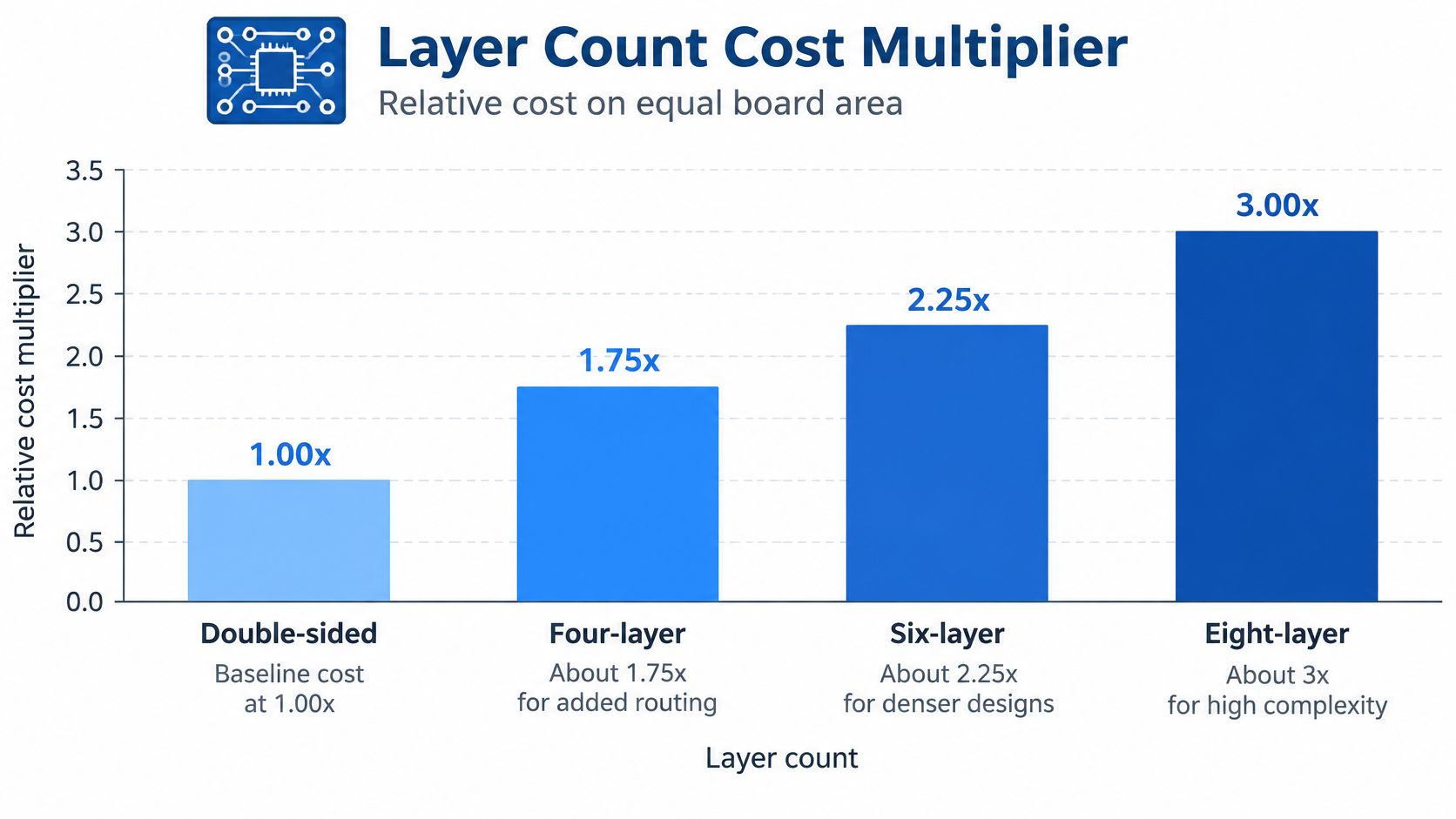
These are relative estimating benchmarks, not guaranteed supplier multipliers. They compare equal board area, not equal routing capability, electrical performance, or finished product size.
Extra layers require more than additional copper. The fabricator must image and etch inner layers, align the stack, laminate it, drill and plate interconnections, and inspect the result. A defect introduced during an earlier operation can make later processing worthless.
Don't assume every layer increase adds a separate lamination cycle. The stack-up and via architecture determine the processing sequence, particularly when sequential buildup is involved.
<a id="panel-fit-can-outweigh-a-smaller-outline"></a>
Panel fit can outweigh a smaller outline
Fabricators process production panels, not isolated finished boards. Routing clearance, tooling rails, coupons, breakaway tabs, and board orientation all affect how many usable boards fit.
As a hypothetical example, suppose a four-layer design fits 20 boards per panel, but a revised outline fits only 16. With unchanged panel-processing cost and yield, the allocated panel cost per board rises by 25%, calculated as 20 divided by 16, minus one. That's an illustrative calculation, not a supplier price promise.
A smaller outline can therefore cost more if it nests poorly. Before moving connectors or trimming an enclosure-driven shape, have manufacturing engineering compare panel layouts.
The embedded video provides a manufacturing reference alongside that review.
<iframe width="100%" style="aspect-ratio: 16 / 9;" src="https://www.youtube.com/embed/3ND-LaJuBcU" frameborder="0" allow="autoplay; encrypted-media" allowfullscreen></iframe>For a useful DFM discussion, provide:
- Finished geometry: Include dimensions, slots, cutouts, edge clearances, and permitted rotation.
- Panel constraints: Identify assembly rails, fiducials, depanelization requirements, and any customer-mandated array.
- Electrical requirements: Supply the stack-up, drill table, minimum trace and space, and impedance targets.
The right optimization target is saleable boards per manufacturable panel, not minimum outline area at any cost.
<a id="copper-weight-and-special-materials-that-raise-cost"></a>
Copper Weight and Special Materials That Raise Cost
LCSC's discussion of PCB material and thickness standards gives a broad industry benchmark: increasing outer-layer copper from 1 oz to 2 oz can raise fabrication cost by roughly 50% to 100%, while copper heavier than 2 oz may add another 20% to 50% per layer.
| Copper weight | Cost effect versus 1 oz | Typical use | |---|---|---| | 1 oz outer copper | Baseline | Signal boards and general electronics | | 2 oz outer copper | +50% to +100% | Higher-current paths and power layers | | Above 2 oz per layer | Further +20% to +50% per layer, not a universal total premium | Heavy-power and high-current designs |
These ranges are screening guidance, not an additive pricing formula. The heavier-copper increment shouldn't be treated as a complete premium against the baseline without the fabricator's stack-up-specific calculation.
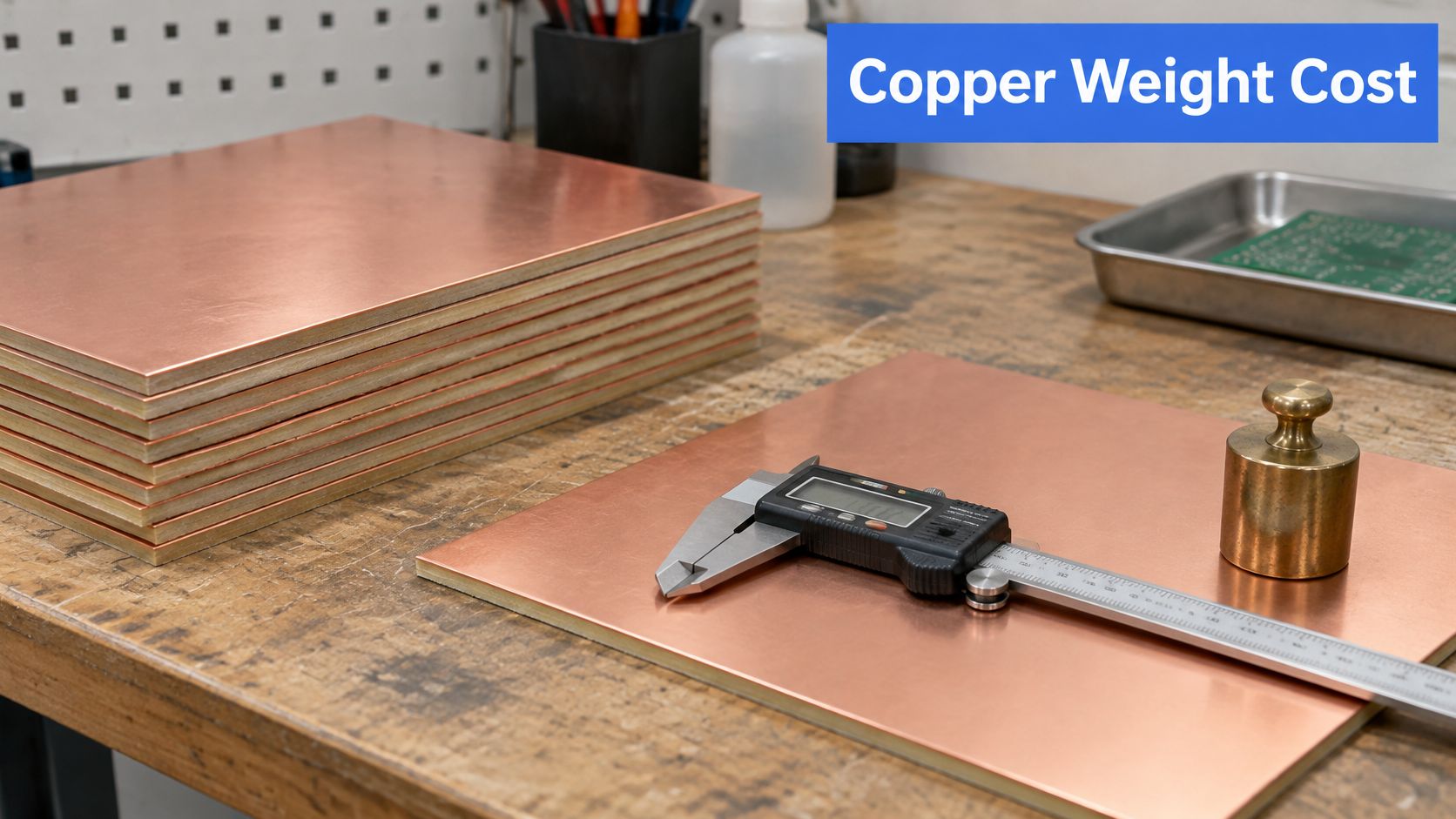
Thicker copper takes longer to plate where plating is required and becomes harder to etch accurately. Lateral undercut changes the practical line-and-space window, while raised features can require additional resin fill during lamination.
That makes all-heavy-copper construction a potentially expensive default. A power path may need substantial copper while adjacent fine-line signal circuitry doesn't.
<a id="assign-material-by-function"></a>
Assign material by function
A mixed-copper stack-up can concentrate current capacity on the layers that need it. Keep signal-layer copper compatible with routing density, then have the fabricator verify stack symmetry, resin requirements, and the finished construction.
Substrate choice needs the same discipline. Standard FR-4 provides a useful baseline, while high-Tg, low-loss, PTFE/Rogers, ceramic, and metal-core constructions introduce different material and processing requirements. They aren't interchangeable upgrades.
For a thermal design, our ceramic PCB manufacturing guide provides context for comparing ceramic construction with other substrate choices. We offer ceramic boards, but the procurement decision should begin with the thermal and electrical requirement rather than the material name.
- Current and temperature rise: Define operating current, conductor geometry, and allowable heating before assigning copper.
- Signal performance: State dielectric-loss needs and impedance tolerance instead of requesting a premium laminate without a target.
- Thermal path: Specify operating temperature and thermal resistance requirements, including how heat reaches the enclosure or heatsink.
Specify the least costly construction that meets the validated limits, not the most expensive material available.
Also distinguish starting copper from finished copper in the drawing. An ambiguous copper requirement can produce quotations that look comparable while describing different manufactured boards.
<a id="quantity-and-lead-time-in-the-final-price"></a>
Quantity and Lead Time in the Final Price
A prototype can consume little laminate yet carry a high unit price. CAM preparation, engineering review, tooling, programming, and test setup don't disappear because the order is small.
A useful estimating model is unit price = recurring manufacturing cost + allocated setup cost. As an unchanged design moves from prototype to pilot and production, the setup allocation per board falls. Recurring cost still depends on the construction and manufacturing process.
Our turnkey PCB assembly has no minimum order quantity, and prototypes can start with one board. That lets a development team buy the build it needs for validation rather than purchase an oversized batch solely to reach a lower advertised unit price.
<a id="request-a-quantity-and-schedule-matrix"></a>
Request a quantity and schedule matrix
Instead of requesting a single circuit board price, send a structured purchasing request:
- Prototype quantity: Match the immediate bring-up and destructive-analysis needs, with engineering charges separated.
- Pilot quantity: Cover process validation and realistic assembly testing using the intended production files.
- Production quantity: State expected release size and whether orders will arrive together or through scheduled releases.
- Lead-time alternatives: Request standard and expedited options, including material readiness and the event that starts the clock.
Our quick-turn PCB assembly service is an option when schedule matters. Keep fabrication acceleration, component expediting, and transport upgrades separate so you can identify which expenditure advances delivery.
<a id="quote-validity-is-a-purchasing-condition"></a>
Quote validity is a purchasing condition
A quotation needs an expiry date and a clear material commitment. Ask whether the quoted laminate and components are reserved, whether purchasing begins only after payment, and what happens if approval is delayed.
Schedule check: A short manufacturing lead time is useful only when the required materials are available and the production files are approved.
Distinguish ship date from arrival date, and identify any customer approvals excluded from the quoted lead time. Otherwise, procurement and engineering can agree to a schedule while counting from different starting points.
Finally, compare batch savings with inventory exposure. Buying ahead can reduce the manufacturing price per board while increasing the amount at risk if firmware validation reveals a hardware change or demand falls short.
<a id="landed-cost-including-shipping-duties-and-surcharges"></a>
Landed Cost Including Shipping, Duties and Surcharges
| Term | Freight paid by | Import duties paid by | What it means for the quote | |---|---|---|---| | EXW, ex works | Buyer | Buyer | Factory price excludes onward logistics; buyer generally arranges collection and export formalities | | FOB, free on board | Buyer for main carriage | Buyer | Seller handles export clearance and delivery aboard the vessel at the named port | | DDP, delivered duty paid | Seller | Seller | Seller prices delivery and import clearance to the named destination, normally ready for unloading |
A low factory quote isn't necessarily the lowest landed cost. Freight, brokerage, duties, currency conversion, insurance, and incoming inspection can reverse the apparent ranking.
Delivery terms must include a named place or port, not just an abbreviation. FOB is a sea or inland-waterway term, so don't use it casually for an air-courier shipment. For DDP, confirm the named destination, tax treatment, and who can legally perform import clearance.
<a id="identify-what-can-change-after-approval"></a>
Identify what can change after approval
Mordor Intelligence's copper-clad-laminate market analysis puts copper at approximately USD 11,200 per metric ton in October 2025 and cites J.P. Morgan's 2026 projection of USD 12,075 per metric ton. The projection is a forecast, not a confirmed annual outcome.
That distinction matters in contracting. A supplier may purchase material after quotation, leaving a gap between the quoted input cost and the actual purchase cost.
Ask which charges are fixed, indexed, or subject to surcharge. An indexed clause should identify its reference, adjustment trigger, relevant purchasing date, and whether decreases pass through as well as increases. Don't accept an undefined materials surcharge.
Keep these items separate:
- Manufacturing: Bare-board fabrication, assembly, tooling, and engineering.
- Procurement: Components, approved substitutions, and purchasing-related charges.
- Transport: Freight, insurance, brokerage, and delivery upgrades.
- Government charges: Customs duties and applicable taxes.
- Exceptions: Expedite fees, additional inspection, or customer-authorized changes.
<a id="compare-destination-totals"></a>
Compare destination totals
Build a comparison sheet using the same destination, currency basis, delivery scope, and acceptance requirements. Record exclusions next to the total rather than leaving them in quotation footnotes.
For import classification, provide the broker with the actual product description and origin. Don't assume that a tariff affecting a copper product automatically applies to every finished PCB containing copper.
The purchasing decision should identify who absorbs each cost change between approval, material purchase, production, and shipment. Without that allocation, a seemingly fixed circuit board price may still produce an uncertain invoice.
<a id="why-the-cheapest-quote-can-cost-more"></a>
Why the Cheapest Quote Can Cost More
Compare cost per passing board, not cost per fabricated board. The denominator should be boards that meet agreed acceptance criteria, not boards delivered in a carton.
Consider competing offers for an RF assembly. The cheaper option omits a defined laminate and impedance verification, while the other includes both. If the first build fails the RF acceptance test, its nominal saving must cover replacement boards, lost components, debugging, and the delayed validation schedule before it represents better value.
The EMSNOW procurement outlook recommends comparing usable-board cost and using staged quotations that identify engineering review, test requirements, first-article yield assumptions, and volume breakpoints. That's a stronger purchasing framework than ranking bids by their headline unit price.
<a id="pay-for-controls-tied-to-a-failure-mode"></a>
Pay for controls tied to a failure mode
Not every premium process earns its cost. Each added control should address a specific risk.
- Controlled impedance: Appropriate when a high-speed interface depends on a defined transmission-line structure.
- Specified RF laminate: Useful when dielectric properties and loss affect the front end's acceptance limits.
- X-ray inspection: Relevant to hidden solder joints that optical inspection can't directly assess.
- Thermal substrate: Justified when the thermal path determines whether the assembly meets operating limits.
- DFM review: Valuable before fabrication when geometry or assembly details need correction without scrapping hardware.
Our full-turnkey SMT, THT, and mixed assembly supports BGA and fine-pitch work, from 01005 to BGA/QFN components, with AOI, X-ray, and FCT testing. These capabilities support an agreed inspection plan; they don't remove the need to define what constitutes a passing assembly.
<a id="purchase-evidence-in-stages"></a>
Purchase evidence in stages
Structure the quotation around engineering release, first-article acceptance, and repeat production. Identify the documents and test results needed before the next stage begins.
For a PCB fabrication service, that might mean approving the stack-up and DFM responses before release, then reviewing dimensional and electrical results before assembly. For assembled boards, define test fixtures, firmware loading, limits, and responsibility for failure analysis.
A yield assumption belongs in the commercial comparison only when the supplier and buyer agree on the test that determines yield.
Calculate cost per passing board by dividing the relevant landed build cost, including attributable rework and replacement costs, by accepted units. Keep speculative launch losses separate from directly measured costs so the comparison remains auditable.
A higher quotation wins only when its additional controls, evidence, or delivery commitments justify the difference. A low price without defined acceptance criteria isn't a comparable offer.
<a id="prepare-your-files-and-request-an-accurate-quote"></a>
Prepare Your Files and Request an Accurate Quote
An accurate quote starts with a coherent manufacturing release. Gerbers, drawings, assembly data, and purchasing instructions should identify the same revision, with exceptions resolved before production approval.
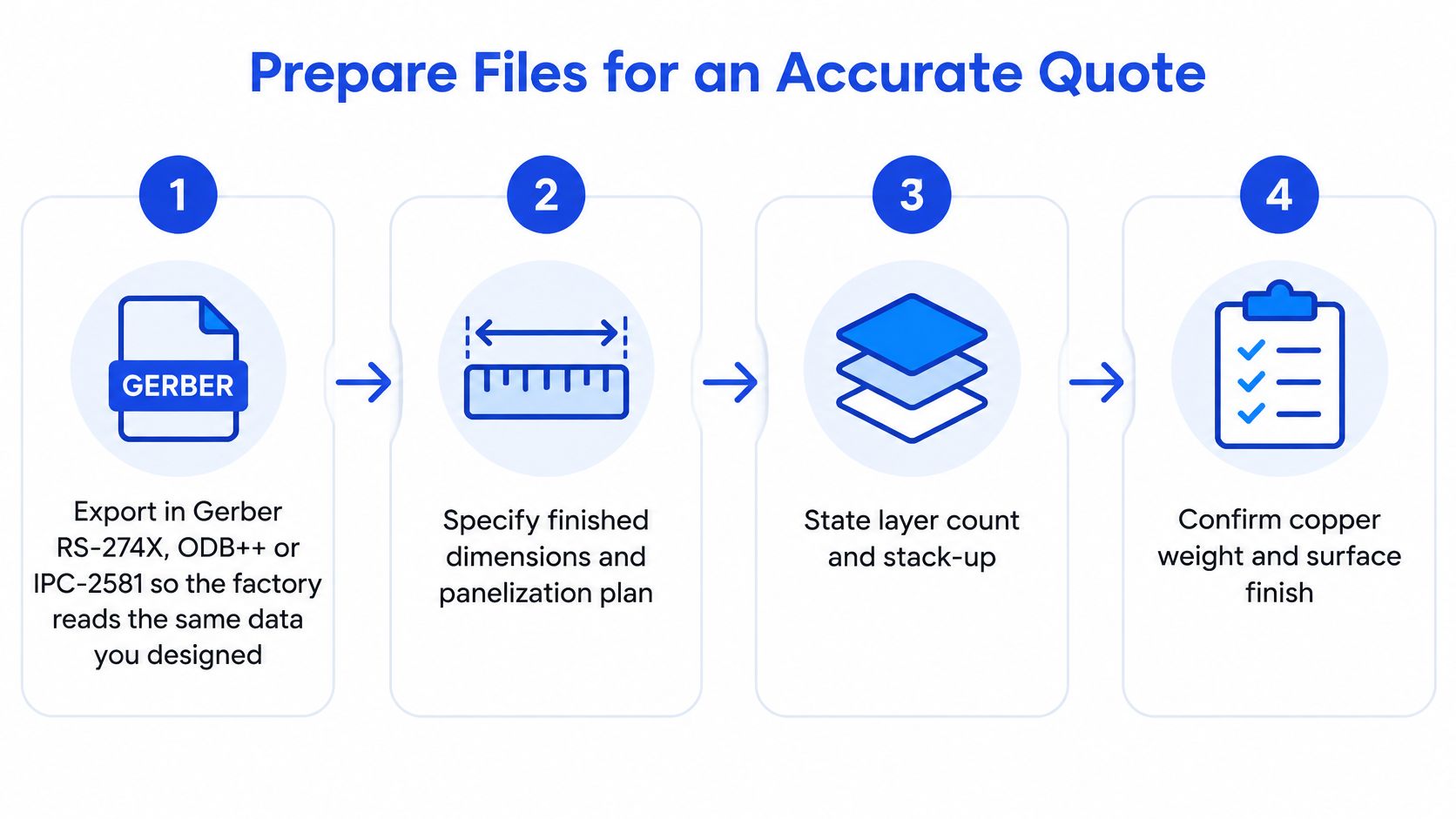
Use this preparation sequence to organize the core design information.
<a id="build-the-technical-package"></a>
Build the technical package
-
Export a supported manufacturing format. We accept Gerber RS-274X, ODB++, and IPC-2581. Include the applicable drill and fabrication documentation, and check the exported files in a viewer rather than relying only on the CAD layout.
-
Define geometry and construction. Supply finished dimensions, the panelization plan, layer count, stack-up, drill table, minimum trace and space, and impedance requirements. Identify which dimensions or constraints the manufacturing engineer may adjust.
-
Assign copper by layer. State copper requirements explicitly and distinguish starting from finished thickness. Mark power and thermal requirements so a proposed construction change can be evaluated against the actual design intent.
-
Name the substrate and surface finish. Specify FR-4, high-Tg, high-frequency, metal-core, or another required construction, including any approved equivalents. Explain the electrical or thermal requirement that restricts substitution.
<a id="add-the-commercial-and-acceptance-package"></a>
Add the commercial and acceptance package
-
List quantity tiers and delivery needs. Give prototype, pilot, and production release quantities, along with the required destination arrival date. Separate firm releases from forecasts so purchasing assumptions are visible.
-
Define the test scope. Identify bare-board electrical testing, AOI, X-ray, flying-probe, or functional testing as appropriate. For functional test, include the procedure, firmware, fixture responsibility, pass limits, and required result records.
-
Choose the engagement model. We offer turnkey, consigned full-kit, and partial-turnkey assembly. We hold component inventory in the turnkey model, the customer holds it in the consigned model, and inventory risk is shared for partial turnkey.
-
Request a comparable commercial offer. Require quote validity, delivery term, named destination, line-item charges, exclusions, and the acceptance basis. For assembly, include a revision-controlled BOM and placement data so sourcing and production quote the same build.
Our turnkey service combines bare-board fabrication, component sourcing, and full assembly under one roof, with one quality system and one point of accountability. That arrangement gives the buyer a defined owner for coordinating the manufacturing release.
Send the complete package with a clear revision identifier and a named technical contact. A short list of unresolved requirements is more useful than allowing a supplier to fill gaps with assumptions that later change the price.
Lianyuhong Technology Co.,Ltd offers PCB fabrication and turnkey assembly for prototype through production requirements, combining board manufacturing, component sourcing, and assembly. Visit Lianyuhong Technology Co.,Ltd and send your design files, BOM, quantity tiers, test requirements, and delivery destination to request a circuit board price you can evaluate on landed cost and accepted-board value.