
The usual buying advice says to award the PCBA manufacturer with the lowest joint price and the shortest prototype turn. That advice fails as soon as a part goes end of life, a regulator asks what is on the board, or a field return needs a repair history. A five-board quick turn is a weak buy if the shop cannot export lot-level traceability, written substitution approvals, and repair records for the product's full life.
I would rather pay more on the first lot and keep a file I can still open in year seven. Price and days still matter. They come after the board class, the package yield, and the record that outlasts the carton.
Table of Contents
- Match the Board to Real Factory Capability
- How to Vet a PCBA Manufacturer
- Judge Yield by Package Not by Shipment
- Control Substitutes and Keep the Build Record
- Trade Lead Time Against Volume and Freight
- Vendor Call Questions and Pilot Award
<a id="match-the-board-to-real-factory-capability"></a>
Match the Board to Real Factory Capability
Three jobs can sit on the same desk. A two-layer IoT sensor on ordinary FR-4. An HDI radio built around a 0.3 mm CSP. An LED driver whose heat leaves through the board, not the air. A PCBA manufacturer both fabricates the bare board and places the parts, so a fab-only quote or an assembly-only quote is the wrong shape. You are buying one process chain.
Most of the credible capacity for that chain sits in Asia. Testimony to the U.S.-China Economic and Security Review Commission states that the United States once produced nearly 30% of the world's PCBs and produces about 4% today, while approximately 90% of global PCB production now occurs in Asia and China alone accounts for more than half of world output. Fabrication there sits next to laminate supply, distributors, testers, and export lanes. Buyers outside the region still own freight, paperwork, and a backup plan. Regional density does not prove that this shop has built your class of board.
<a id="keep-only-the-rows-this-revision-uses"></a>
Keep only the rows this revision uses
Ignore every class the current revision does not use. For each row you keep, require a recent build of that class, not a line on a capability slide.
| Class | Evidence to request | Pass look | | --- | --- | --- | | Rigid FR-4, including multilayer | Stack-up, layer count, impedance coupons | Documented stack-up and coupons within ±10% of the target impedance | | HDI | Microvia and finest BGA build record | Laser microvias and a shipped fine-pitch BGA, not a catalog limit | | Flex and rigid-flex | Layer count, coverlay, bend radius | A bent sample of the same construction | | Metal-core | Aluminum or copper core and copper weight | A thermal path for LED or power, not standard FR-4 | | High-frequency | Laminate name and loss or impedance method | Rogers, PTFE, Taconic, or a hybrid stack with data | | Ceramic | Substrate and process | Al2O3 or AlN, DBC or thick-film, matched to heat and dielectric needs | | SMT, THT, or mixed assembly | Package range and hidden-joint plan | 01005 through BGA or QFN, with X-ray where joints are hidden |
Say the radio is the live job. Keep HDI and the SMT row. Ceramic and metal-core wait until a later revision needs them. If the LED driver is the live job, metal-core or ceramic is mandatory, and an FR-4 coupon is not evidence. High-frequency laminates need a named material and a stated loss or impedance method. A generic "RF capable" line is not a pass.
Connectors, high-current leads, and mechanical hardware often still need through-hole PCB assembly on the same panel as fine-pitch SMT. Mixed technology is its own evidence row.
Write two or three mandatory rows on the scorecard before anyone talks price. The IoT sensor might be rigid FR-4 plus mixed assembly. The radio is HDI plus SMT with X-ray. The hot driver is metal-core or ceramic plus the thermal stack. Later checks test only those risks.
<a id="how-to-vet-a-pcba-manufacturer"></a>
How to Vet a PCBA Manufacturer
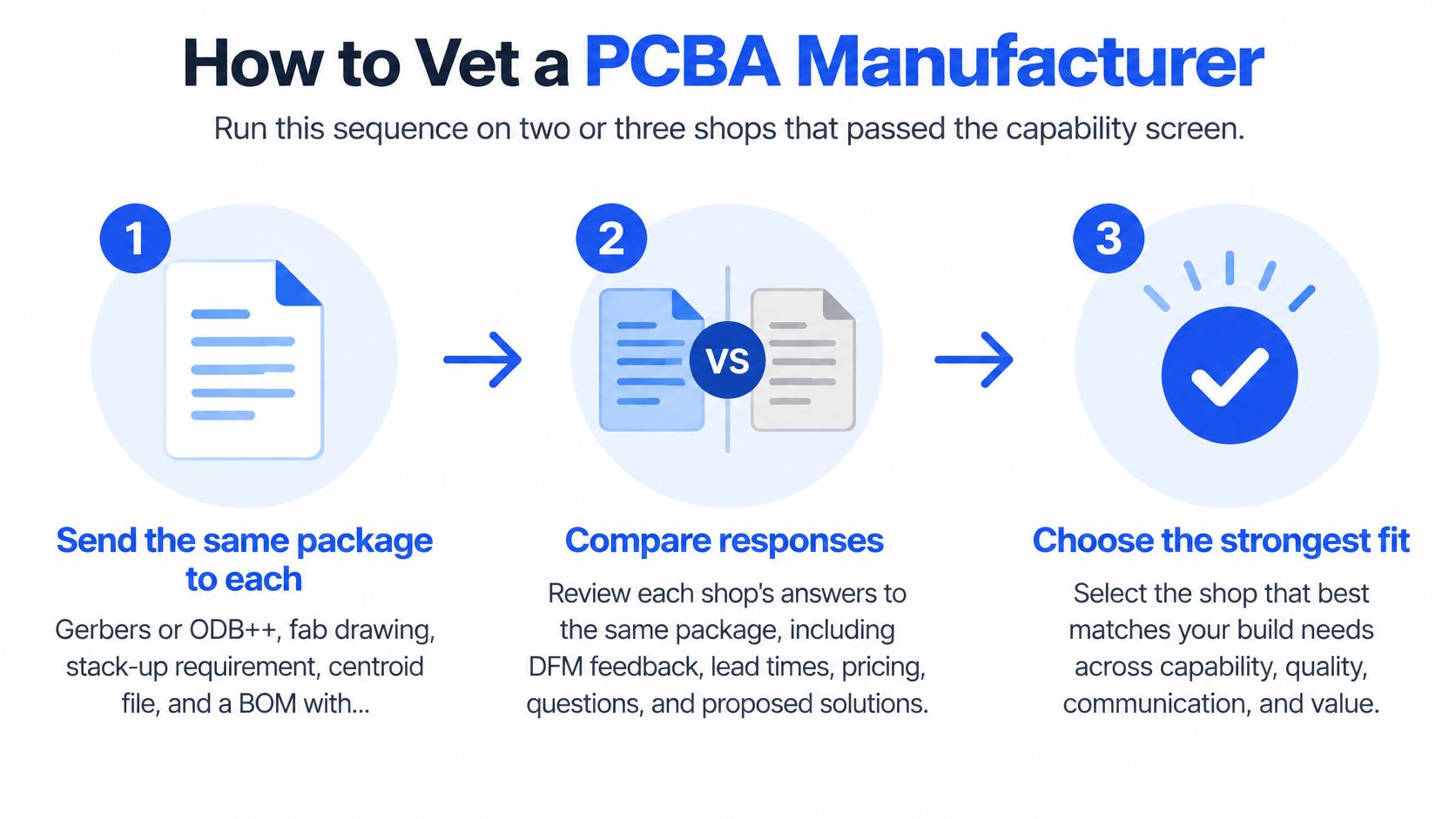
Run one sequence on two or three shops that already cleared the capability screen. A lower unit price does not enter until the files, the DFM, and the certificates match the product you sell.
<a id="six-steps-before-you-score-a-quote"></a>
Six steps before you score a quote
-
Send one identical package. Include Gerbers or ODB++, the fab drawing, the stack-up requirement, the centroid file, and a BOM with manufacturer part numbers. State the IPC class you intend to buy. Class 2 fits most commercial products. Class 3 is the buy for high-reliability work. A shop that says "just send the Gerber" and skips the centroid has already shown how the first build will go.
-
Require a written DFM before any commitment. The report should cover pad and mask issues, polarity, fiducials, panelization, and any part the line cannot place. Why this step exists: errors found after stencil order are paid twice, once in scrap and once in schedule. No written DFM is a disqualifier, even at the lowest unit price.
-
Name who owns the BOM. Turnkey means the shop buys, fabricates, and assembles. Consigned means you own shortages, date codes, and kitting mistakes. A verbal blend with no owner for a missing reel is how a "three-day" build becomes three weeks. Put the owner in the quote.
-
Match certificates to the product, not the homepage. ISO 9001 is the baseline quality system. ISO 13485 matters when the build is a medical device. IATF 16949 matters for automotive electronics. Add UL recognition and RoHS or REACH declarations where the selling market requires them. Our fabrication is IATF 16949 certified for automotive work, medical assembly runs under an ISO 13485 system, and we are a UL recognized PCB manufacturer using RoHS and REACH compliant materials. Use a certificate only when your customer will audit it. A wall of unused logos is noise.
-
Lock the inspection path for your package family before you discuss days. SPI, AOI, and X-ray answer different questions. A shop that will not show a sample X-ray of a similar BGA is out, regardless of the calendar it offers.
-
Score quotes only after steps 1 through 5. Use one scorecard on identical quantity breaks: DFM quality, evidence supplied, lead time, and total landed cost. Do not average a missing X-ray into a friendly total.
Practical rule: Name one winner for the pilot lot, not for the life of the product. A longer award waits on yield figures and a lot file you can actually open.
<a id="judge-yield-by-package-not-by-shipment"></a>
Judge Yield by Package Not by Shipment
A 100% ship rate can hide a process that only works on large passives. The IPC industry benchmark tracks first-pass yield, final-inspection yield, internal SMT and soldering yields, inspection-method usage, and defects per million opportunities (DPMO). Those numbers beat a simple shipment pass rate because rework and easy parts can inflate the carton count.
<a id="what-the-fine-pitch-numbers-actually-say"></a>
What the fine-pitch numbers actually say
An IPC technical study put the risk on the package, not the board average. A 0.3 mm CSP produced 173 defects across 600 opportunities, about 288,333 DPMO. 0201 parts produced 142 defects across 348,000 opportunities, about 408 DPMO. 01005 parts produced 6 defects across 195,000 opportunities, about 31 DPMO. A handful of ultra-fine opportunities can dominate the build even when the raw defect count looks smaller than the passive count.
| Package | Defects | Opportunities | Approx. DPMO | | --- | --- | --- | --- | | 0.3 mm CSP | 173 | 600 | 288333 | | 0201 | 142 | 348000 | 408 | | 01005 | 6 | 195000 | 31 |
Qualify on the hardest package in the BOM. A clean run of 0603 passives does not transfer to a 0.3 mm CSP. BGA PCB assembly with hidden joints belongs in that same qualification, not in a separate "we'll X-ray if there's time" note.
<a id="pilot-controls-that-belong-on-the-first-build"></a>
Pilot controls that belong on the first build
Check stack-up, pad geometry, libraries, polarity, and manufacturability rules before Gerbers, centroid data, and the BOM leave your desk. On the line, measure paste volume, height, area, and position with 3D SPI, then tie outliers to aperture design, warpage, squeegee setup, and paste condition. Use AOI for presence, polarity, alignment, tombstoning, bridges, and visible joints. X-ray covers BGA, QFN, LGA, and other bottom-terminated joints. Flying probe, ICT, or functional test then covers the nets those cameras cannot prove.
For the pilot, record SPI distributions and oven readings at several places on the panel. Classify bridges, insufficient collapse, head-in-pillow, and voids separately, and calculate DPMO by package family. That same IPC study found excessive bridging to be a prominent failure mode on the fine-pitch devices, so the fix is aperture geometry, paste volume, alignment, and reflow. More AOI does not repair a bad print.
Require a monthly Pareto by process stage, plus first-pass yield, rework rate, escape rate, and corrective-action closure time, split by package family. Do not let AOI stand in for X-ray. Do not mix cosmetic IPC notes with functional defects. On the first build, ask for three numbers only: FPY, DPMO for the finest package, and escape rate.
<a id="control-substitutes-and-keep-the-build-record"></a>
Control Substitutes and Keep the Build Record
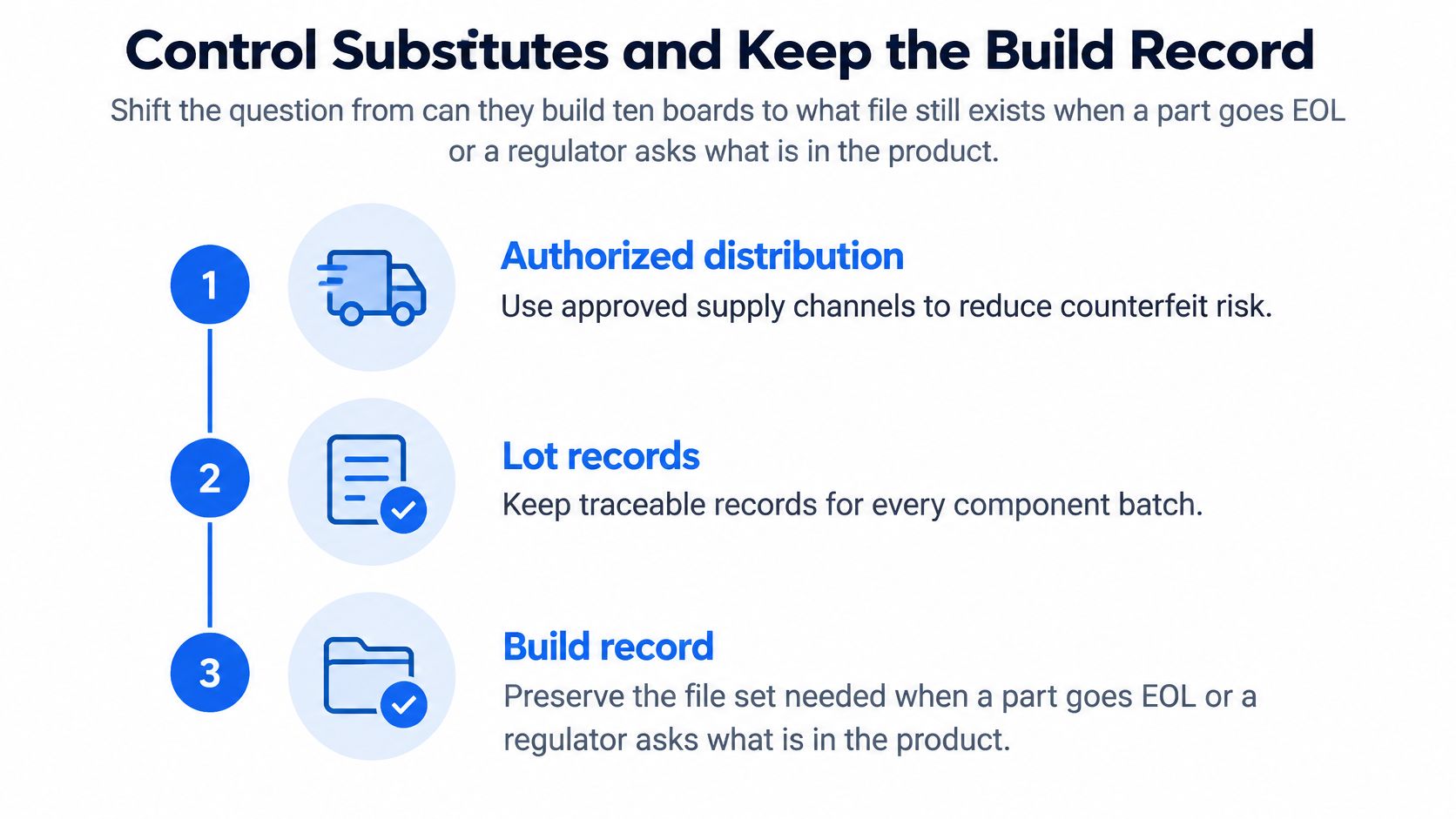
Can they build ten boards is the wrong question once a part goes EOL or a regulator asks what is in the product. Authorized distribution and lot records cut counterfeit risk. They do not remove allocation, mineral concentration, or obsolescence. A supply-chain analysis from the University of Virginia_nsdpi_microelectronics_supply_chain_analysis_1.pdf) notes that cobalt mining is led by the Democratic Republic of the Congo, refined cobalt production and consumption are dominated by China, and China exports roughly 40% of global tantalum-product value. Copper represents about 25–35% of total PCB material cost and can be a larger share on specialty or high-copper boards. A single-source passive is a resilience problem, not only a purchasing problem.
Traceable buying still has to prove that a substitute is electrically, mechanically, thermally, and regulatory-equivalent before it ships. Low-volume products rarely hold allocation, so the alternate has to be qualified while the first source is still available.
The European Commission's 2025 sustainable-product communication treats durability, spare parts, repairability, recyclability, and product information as possible ecodesign criteria, and it describes Digital Product Passports as a way to show material composition and substances of concern. Not every PCBA is in scope. A missing lot record is still expensive to rebuild later, and a cheap prototype with no exportable history is the costly option.
This short walk-through is a useful picture of why the purchasing file and the build file are different jobs.
<iframe width="100%" style="aspect-ratio: 16 / 9;" src="https://www.youtube.com/embed/IgDAKCtGyIw" frameborder="0" allow="autoplay; encrypted-media" allowfullscreen></iframe><a id="what-has-to-exist-before-an-alternate-ships"></a>
What has to exist before an alternate ships
- Approved vendors: Name the distributors and the manufacturers, not "the open market."
- Lot and date code: Tie every reel to the boards it built.
- Change notices: Someone reads PCNs and EOL notices on a set cadence.
- Second source: Score lifecycle risk on long-life SKUs and qualify the backup while the first part still ships.
- Written stop: No alternate leaves the building until you accept equivalence.
<a id="retention-clause-to-paste-into-the-purchase-order"></a>
Retention clause to paste into the purchase order
- Supplier keeps serial or batch board identity, component lot and date-code records, and revision history for the full product life.
- Supplier provides repair records, material declarations, and controlled-change notices on request.
- No substitute part ships until the buyer approves it in writing after electrical, mechanical, thermal, and regulatory equivalence is shown.
- Supplier notifies the buyer of product-change and end-of-life notices within a stated period.
Add basic disassembly notes if a recycler or repair network will ever see the assembly. A one-page clause beats a slide that promises "full traceability" and then emails a packing list.
<a id="trade-lead-time-against-volume-and-freight"></a>
Trade Lead Time Against Volume and Freight
Three commercial situations get mixed into one "lead time" and then disappoint everyone.
Prototype, about 5 to 10 boards. Assembly can land in 24 hours to 5 days only when every part is already kitted. Unit cost is highest because the stencil, programming, and engineering sit on a handful of boards.
Low volume, roughly 10 to 500 pieces. This is the band many hardware startups work in. Plan on about 1 to 2 weeks. A no-minimum shop and cut-tape buying matter more than a volume break you will not hit.
Ongoing production, about 1,000 pieces and up. Expect about 3 to 6 weeks to the first article, then scheduled releases. Unit price drops. Allocation risk and change-notice risk rise.
| Stage | Assembly clock | Cost and risk | | --- | --- | --- | | Prototype | 24 hours to 5 days when parts are already kitted | Highest unit cost; stencil and engineering dominate | | Low volume | About 1 to 2 weeks | Mid unit cost; cut-tape and no minimum matter more than price breaks | | Volume | About 3 to 6 weeks to first article, then scheduled | Lowest unit cost; allocation, change notices, and freight buffers dominate |
<a id="three-clocks-not-one-quote-line"></a>
Three clocks, not one quote line
Fabrication sets the bare-board clock. Sourcing sets the parts clock. Freight sets the door date. A quoted 24-hour build that assumes free-issued parts is not the same offer as turnkey purchasing. Freeze the BOM before the quick-turn clock starts. Do not chase the lowest joint price on a fine-pitch board that has not cleared X-ray.
World Bank WITS data, based on UN Comtrade, recorded China's 2024 exports of printed circuits under HS 853400 at approximately US$20.183 billion, up from US$17.512 billion in 2023. That code covers printed circuits, not every assembly technology or all factory revenue, but it does mark a dense component and freight network. For buyers outside the region, add door time on DHL, UPS, or FedEx, customs brokerage, and a buffer for a respun panel. Quick-turn PCB assembly only helps the assembly clock. It does not shrink a missing reel or a held shipment.
Pick one row as the commercial model on the purchase order. A prototype price on a volume forecast, or a volume lead time on five boards, is how both sides argue later.
<a id="vendor-call-questions-and-pilot-award"></a>
Vendor Call Questions and Pilot Award
Use the call to test whether the winner of the paper screen can answer in specifics. Stop if any reply is a brochure line.
- Which of my board classes have you shipped in the last 90 days, and can I see that traveler? A catalog limit is not a traveler.
- Which IPC class will you build to, and who signs the DFM? You want a name, not "engineering."
- Will you buy the BOM or only place my parts, and what is your written substitute rule? If they cannot say who stops an alternate, they do not have a rule.
- Which of SPI, AOI, X-ray, flying probe, and functional test run on this package, and can you report first-pass yield and DPMO for the finest part? If they offer a ship rate instead, ask again once, then end the call.
- Which lot, revision, repair, and material records will you export for the life of the product? "We keep records" is not an export list.
- What is the assembly clock for my quantity if parts are not yet in the building, and which carrier clears my country? Separate the unkitted clock from the kitted one.
If the design needs one accountable party from bare board through assembly, quote a turnkey PCBA manufacturer such as Lianyuhong Technology against the same Gerber, BOM, and quantity row. Turnkey here means bare-board fabrication, component sourcing, and full assembly under one quality system and one point of accountability. Every board is manufactured to IPC-2 or IPC-3 standards with 100% AOI, flying probe, and electrical testing. Require that certificate set and that test coverage in writing before the pilot.
Award only a pilot lot until the yield figures and the lot file come back complete. I would not release a production blanket on a friendly quote and a promise to "send traceability later."
Lianyuhong Technology Co.,Ltd builds and assembles boards in Shenzhen, from rigid, HDI, flex, metal-core, high-frequency, and ceramic fabrication through turnkey SMT and through-hole assembly, with the inspection and lot records a long-life product needs. If you are ready to put a real Gerber and BOM against that process, visit Lianyuhong Technology Co.,Ltd and send the package for a pilot quote.