
Your schematic is finished, the enclosure team needs hardware, and the lowest PCB quote looks like an easy saving. Then the boards arrive without the agreed test results, and your engineers spend bring-up time separating assembly defects from design mistakes. Choosing a prototype PCB supplier means buying a documented path to usable hardware, not just a fabrication slot.
Table of Contents
- Why Your Prototype PCB Supplier Shapes the Whole Launch
- Seven Criteria for Comparing Prototype PCB Suppliers
- Real Lead Time Behind a Quoted Fabrication Date
- Plated Copper and IPC Class Checks That Matter
- Assembly Inspection That Catches Hidden Defects
- Sustainability and Waste on Small Prototype Orders
- Release the Prototype Order
<a id="why-your-prototype-pcb-supplier-shapes-the-whole-launch"></a>
Why Your Prototype PCB Supplier Shapes the Whole Launch
Say your team selects the cheapest bid because the supplier promises fast fabrication. Nobody confirms who owns component procurement, whether the laminate is reserved, or what “tested” means. The supplier ships electrically checked bare boards, while your team expected assembled hardware ready for firmware loading.
That isn't just a late delivery. It's a mismatch between the purchased scope and the engineering milestone.
A prototype supplier should help you identify manufacturing risks before release and build hardware representative of the intended production design. That doesn't mean every exploratory board needs production-level qualification. It means deviations in materials, stack-up, components, and inspection must be deliberate and recorded.
<a id="geography-changes-the-procurement-decision"></a>
Geography changes the procurement decision
According to David Schild's testimony to the U.S.-China Economic and Security Review Commission, roughly 90% of the world's PCBs are manufactured in Asia, while the United States produces approximately 4%. For buyers, that concentration makes access to materials, component distributors, assembly capacity, and repeat-build capability part of the technical decision.
Shenzhen and the wider Pearl River Delta offer proximity to connected electronics supply chains. A supplier there may coordinate fabrication, sourcing, assembly, and shipment without the buyer managing separate contractors. The trade-off is that international procurement needs explicit ownership of engineering questions, shipping terms, and acceptance records.
Buying rule: Choose the supplier that can explain how your released files become accepted hardware, including what happens when something fails.
A nearby supplier can still outsource critical processes. A distant supplier can still provide strong engineering communication and complete lot records. Ask where the actual work happens, who approves substitutions, and who signs the final release.
The launch risk isn't the supplier's postcode alone. It's the gap between what the quote appears to include and what the supplier has committed to deliver.
<a id="seven-criteria-for-comparing-prototype-pcb-suppliers"></a>
Seven Criteria for Comparing Prototype PCB Suppliers
Prototype PCB supplier scorecard
| Criterion | Strong answer | Red flag | Ask for in writing | |---|---|---|---| | Turnaround | Dated milestones to tested boards | Only a fabrication-only lead time | Milestone schedule with stated assumptions | | DFM review | Engineer comments before the quote | Quote issued with no design check | DFM report with open questions | | Impedance control | Stack-up matched to your target | Generic stack-up for any job | Documented stack-up and tolerance | | Quality data | Microsection and test records | Visual acceptance statement only | Microsection report and lot records | | Assembly inspection | SPI, AOI, and X-ray for fine pitch | AOI-only claims | SPI limits by package family | | Component sourcing | Authorized distributors with lot traceability | Unnamed part sources | Sourcing list with lead time per part | | Sustainability | Measured waste and panel use | Generic green claim | Per-project waste and disposition policy |
Use this as an evidence scorecard, not a sales questionnaire. A supplier saying it can perform an operation isn't equivalent to providing an agreed deliverable for your order.
For an internal rating, mark each row unproven, conditional, or documented. Conditional means the supplier has identified an exception, such as an unresolved material substitution or a test fixture you must supply. Documented means the commitment appears in the quotation, approved engineering response, or quality plan.
<a id="set-the-technical-gate-before-comparing-price"></a>
Set the technical gate before comparing price
Record the supplier's fabrication envelope on the same evaluation sheet:
- Geometry and construction: Maximum layer count, minimum trace and space, finished-hole limits, and supported via structures.
- Electrical control: Controlled-impedance tolerance, coupon method, and bare-board electrical-test coverage.
- Special processes: Whether HDI, rigid-flex, RF, ceramic, and metal-core work is performed in-house or subcontracted.
- Order conditions: Minimum order, panel charges, tooling ownership, and repeat-order requirements.
A fast quote from a factory that can't build the actual stack-up isn't a qualified bid. Nor should an unexplained promise to “adjust the design during CAM” count as DFM approval. Require the supplier to identify proposed changes, and have your engineer approve anything that affects electrical or mechanical performance.
Consider a hypothetical supplier that promises rapid fabrication but can't identify the laminate or confirm availability of the processor. Its schedule answer remains unproven even if its fabrication capability is excellent. Another supplier may quote a later fabrication completion but have reserved materials and a defined assembly slot, making its delivery commitment more credible.
<a id="read-exclusions-as-carefully-as-capabilities"></a>
Read exclusions as carefully as capabilities
For automotive, medical, or industrial builds, I would treat unresolved quality or traceability red flags as release blockers. That includes undocumented component sources, missing lot identification, and refusal to disclose subcontracted critical processes.
Compare the same board revision, quantities, files, inspection scope, and test requirements across suppliers. Otherwise, a lower quote may exclude work included elsewhere.
Ask suppliers to separate fabrication, components, assembly, tooling, inspection, testing, and freight. The point isn't to demand the lowest value in every category. It's to identify what you're buying and what your own team will still need to do.
<a id="real-lead-time-behind-a-quoted-fabrication-date"></a>
Real Lead Time Behind a Quoted Fabrication Date
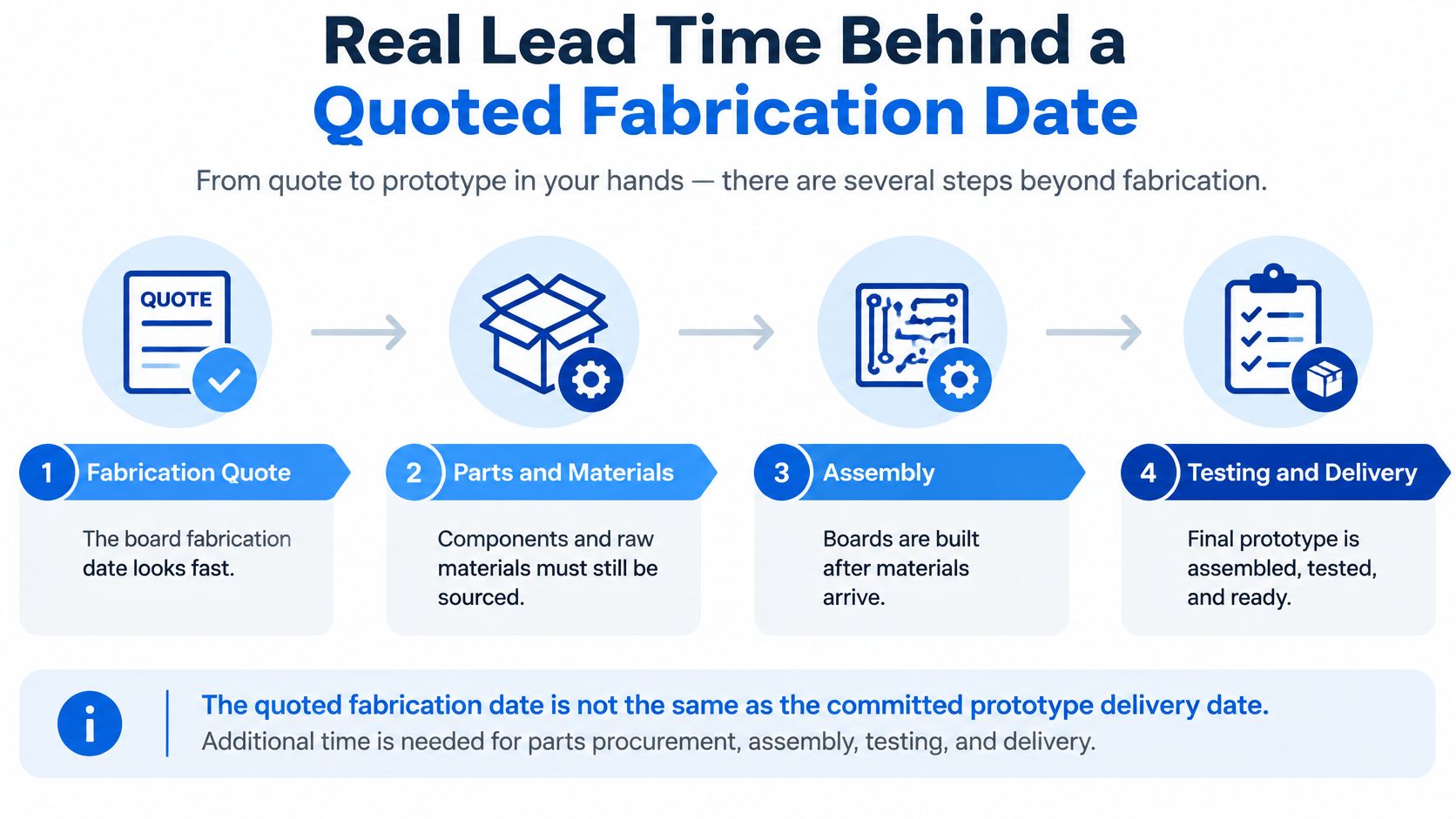
A fast fabrication quote can hide a long wait for the parts and materials the board needs. Assembly can't start because the bare boards are ready if the power-management IC is still unavailable.
All Things Supply Chain's PCB sourcing guidance describes approximately 1–7 days for in-stock authorized-distributor components, 4–12 weeks for factory procurement, 1–52 weeks for allocated parts, and roughly 8–16 weeks for copper foil and laminate. These are sourcing ranges, not automatic additions to every prototype order.
Lead-time dependencies for prototype builds
| Dependency | Typical lead time | Effect on the schedule | |---|---|---| | In-stock components from authorized distributors | 1–7 days | Usually doesn't set the schedule when reserved promptly | | Factory-procurement components | 4–12 weeks | Sets the assembly start date if no approved stock exists | | Allocated components | 1–52 weeks | Can override a fast fabrication slot | | Copper foil and laminate | 8–16 weeks | Can gate fabrication when required material isn't stocked |
The distinction between fabrication completion and delivery is visible in the full build sequence.
<a id="reserve-dependencies-before-paying-for-acceleration"></a>
Reserve dependencies before paying for acceleration
Standard FR-4 may fit an available material inventory. HDI can require additional sequential processing, while rigid-flex, RF, ceramic, and metal-core constructions introduce different material and process dependencies. Require confirmation against your specific construction rather than assuming a general quick-turn service applies.
Customer-supplied parts transfer procurement responsibility, not necessarily schedule certainty. Your supplier still needs to receive, count, identify, and assess the supplied material before committing the assembly slot. With turnkey sourcing, component availability and approved substitutions must be resolved within the supplier's procurement plan.
Our order process starts when you upload Gerber, BOM, and pick-and-place files through a secure portal. Engineers review the design and component availability for DFM feedback, then issue a detailed quotation with transparent pricing and lead-time options. After approval, boards are manufactured, assembled, tested, and shipped worldwide.
For a quick-turn PCB assembly request, add the test procedure and required arrival date to those manufacturing files.
Ask for the committed arrival date of fully assembled and tested boards, plus the assumptions that could move it.
The milestone schedule should name engineering approval, material reservation, component receipt, fabrication, assembly, inspection, functional testing, and shipping. Request on-time delivery of tested boards as the performance measure, with clear treatment of customer-caused holds.
<a id="plated-copper-and-ipc-class-checks-that-matter"></a>
Plated Copper and IPC Class Checks That Matter
Plated-through-hole copper is a reliability feature, not just a connectivity feature. During reflow and field temperature cycling, the copper barrel and surrounding laminate expand differently. Thin or defective plating leaves less margin against thermomechanical fatigue.
JLCPCB's thermal-cycling guidance based on IPC-6012F lists minimum average hole-wall copper of 20 µm for Class 2 and 25 µm for Class 3. Put the applicable performance class and plating requirements in the quotation and inspection plan, rather than relying on a general statement about IPC compliance.
IPC class barrel copper requirements
| IPC class | Minimum average barrel copper | Typical application | Document to request | |---|---|---|---| | Class 2 | 20 µm | General commercial and consumer products | Microsection report with average and minimum barrel copper | | Class 3 | 25 µm | Safety, medical, aerospace, and severe thermal cycling | Class 3 inspection plan and retained reliability coupons |
These average values aren't a complete acceptance specification. A satisfactory average doesn't establish that every inspected location meets the applicable minimum or that the barrel is free of cracks and voids.
<a id="ask-for-evidence-from-the-manufactured-lot"></a>
Ask for evidence from the manufactured lot
The microsection report should identify the lot, sampled structure, measured values, and acceptance result. Request coverage of:
- Barrel copper: Average and minimum measurements, with locations identified.
- Internal geometry: Annular-ring integrity, dielectric thickness, and registration.
- Defects: Plating voids, barrel cracks, and corner cracks.
- Coupons: Whether reliability coupons accompany the production panel, how they represent the board, and how they're retained by lot.
Read these records closely for HDI, backdrilled, and high-layer-count builds. Drill wander, thin lands, and stacked-via structures make local geometry especially important. Don't accept a photograph without dimensions or a pass statement without the applicable criteria.
For safety-related, medical, aerospace, or severe thermal-cycling applications, specify Class 3 or document the engineering rationale for a different choice. Product category alone doesn't replace the end-use reliability assessment.
Our PCB fabrication is IATF 16949 certified, qualifying us as a turnkey PCBA supplier for automotive electronics. That credential doesn't replace the order-specific inspection plan or your product qualification requirements.
Use the PCB design standards guide when preparing fabrication notes, then reconcile those notes with the supplier's proposed stack-up and acceptance documents. Any conflict should be resolved before manufacturing release, not during incoming inspection.
<a id="assembly-inspection-that-catches-hidden-defects"></a>
Assembly Inspection That Catches Hidden Defects
Automated optical inspection can't see through a package. An AOI image may look clean while a BGA or QFN has a defective joint underneath it. A supplier that presents AOI as complete assembly assurance hasn't addressed the hidden-joint problem.
Use complementary inspection stages. Solder-paste inspection, or SPI, measures deposits before placement. AOI checks accessible features and visible solder joints after reflow, while X-ray examines hidden joints and void-related defects.
LTP's published SPI guidance gives approximate deposit-volume tolerances of ±30% for conventional chip components and ±15–20% for 0.4 mm BGA or fine-pitch QFP deposits, with height control around ±20 µm and pad coverage of at least 70%. Treat these as comparison points for the supplier's process library, not universal acceptance limits for every footprint.
SPI limits for prototype solder paste
| Check | Typical limit | Package or case | Why it matters | |---|---|---|---| | Deposit volume | ±30% | Conventional chip components | Low volume risks opens; excess increases bridging risk | | Deposit volume | ±15–20% | 0.4 mm BGA and fine-pitch QFP | Finer pitch needs a tighter printing window | | Deposit height | Around ±20 µm | General process guidance | Insufficient height can contribute to opens and head-in-pillow defects | | Pad coverage | At least 70% | General process guidance | Inadequate coverage can compromise joint formation |
<a id="inspect-the-printing-process-not-just-the-finished-board"></a>
Inspect the printing process, not just the finished board
Insufficient paste can produce opens or contribute to head-in-pillow defects. Excess paste raises bridging risk. As pitch decreases, stencil aperture design and paste release become harder to manage, so an undifferentiated pass threshold isn't enough.
Request the SPI machine model and measurement capability, package-specific library settings, and the method for handling flagged deposits. Also examine solder-paste lot identification, storage controls, stencil thickness, aperture design, and the feedback loop used to correct printing before placement.
A useful question is what happens after an SPI failure. The answer should distinguish reprinting, stencil cleaning, parameter adjustment, and engineering review. Allowing an operator to override the alarm alone doesn't demonstrate control.
Inspection principle: A machine list describes equipment. An inspection record shows what happened to your boards.
For assemblies containing 01005 components, QFN packages, or fine-pitch BGA, require a coordinated SPI, AOI, and X-ray plan, with each method assigned to the features it can inspect. Define this in the PCB prototype assembly scope before ordering.
Functional testing remains a separate acceptance activity. Specify firmware revision, supply conditions, exercised interfaces, expected results, and failure handling. A board that powers on hasn't necessarily passed the tests your engineering milestone requires.
<a id="sustainability-and-waste-on-small-prototype-orders"></a>
Sustainability and Waste on Small Prototype Orders
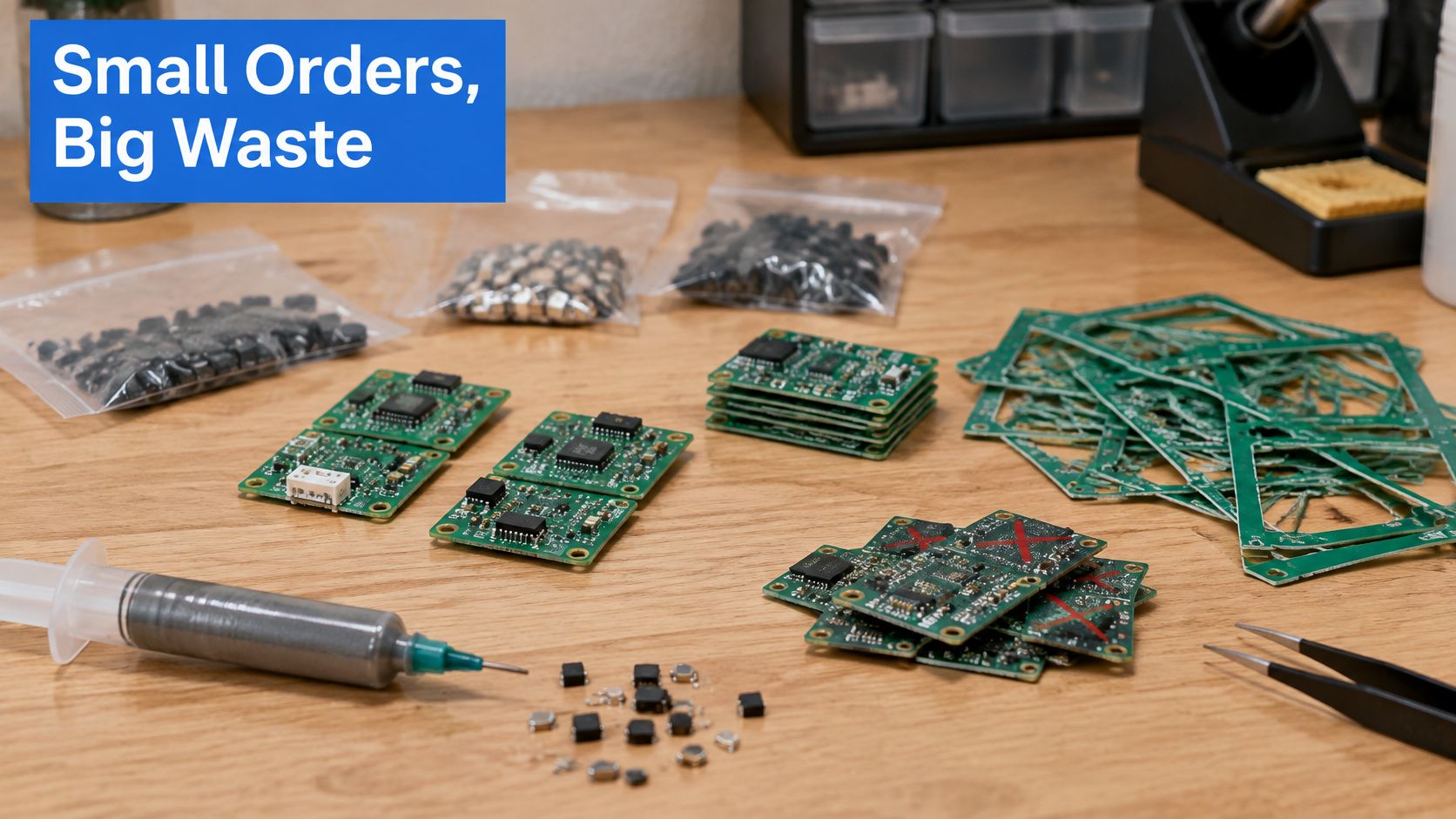
Small orders can still leave substantial scrap. Repeated design spins, unused cut-tape components, excess panel area, discarded solder paste, and failed assemblies all belong in the project's waste picture. Counting only shipped boards misses much of what the build consumed.
An I-Connect007 summary of ICAPE Group's sustainability report estimates that PCB production accounts for about 30% of electronics-manufacturing CO₂ emissions and that less than 20% of global e-waste is properly recycled. Those sector-level estimates justify asking for project evidence, but they don't establish the footprint of your particular board.
<a id="request-a-project-waste-record"></a>
Request a project waste record
Ask the supplier to report quantities it can substantiate and label estimates clearly. A useful record includes:
- Board area and panel utilization: Finished-board area, panel allocation, and estimated material waste.
- Procurement leftovers: Unused components, laminate minimums, and ownership of remaining stock.
- Rework and rejection: Reworked assemblies, scrapped boards, and the disposition of recoverable parts.
- Material handling: Lead-free process controls, segregated scrap, and documentation for recovered materials.
- Transport: Shipment mode and opportunities to consolidate deliveries without missing the engineering milestone.
Repairability matters too. Accessible test points, replaceable components, and a controlled rework policy can keep a repairable prototype out of the scrap stream. However, rework must preserve the electrical and reliability purpose of the test; a heavily repaired board may no longer represent the intended manufacturing process.
RoHS, WEEE, the EU Green Deal, and ecodesign requirements belong in lifecycle planning, but they aren't interchangeable evidence of low environmental impact. Material compliance doesn't tell you how much panel waste a project generated or where rejected assemblies went.
Set the reporting boundary explicitly. If a supplier can report manufacturing scrap but not upstream material emissions, that's a useful limitation to know. A narrow, auditable record is better than an unsupported green claim.
Request the same project fields on repeat builds so procurement and engineering can identify avoidable waste without changing critical materials merely to improve a marketing statement.
<a id="release-the-prototype-order"></a>
Release the Prototype Order
Freeze a common quotation package before selecting the supplier. Send competing bidders the same Gerber revision, BOM, pick-and-place file, fabrication drawing, assembly notes, and acceptance requirements. Include approved alternatives and identify parts that must not be substituted.
The purchase order should reference that package and its revisions. Email discussions are useful for resolving questions, but the final commitment needs to be recoverable without searching through an engineer's inbox.
<a id="complete-the-release-checks"></a>
Complete the release checks
-
Accept the delivery commitment. Confirm a dated path through engineering approval, procurement, manufacturing, acceptance, and shipment. Name the person who must approve changes and the event that starts the quoted lead time.
-
Match fabrication acceptance to the drawing. Resolve conflicts between the specified IPC class, supplier exceptions, microsection coverage, and coupon retention. Attach the approved inspection plan to the order.
-
Approve the assembly evidence package. Identify which inspection reports accompany shipment and how results map to board serial numbers or lot identifiers. Supply the functional-test procedure, firmware, fixtures, and pass criteria before the supplier schedules testing.
-
Close sourcing exceptions. Read the procurement list line by line. Unconfirmed stock, factory-only procurement, allocations, and proposed substitutions need an owner and an approved resolution, not a hopeful note beside the part number.
-
Agree on project disposition. Record what happens to unused components, repairable boards, rejected assemblies, and retained samples. Include the project's material-waste and shipping information in the closeout package.
Suppose the cheaper bidder leaves critical component availability unresolved, while the higher bidder provides confirmed sourcing and a complete acceptance package. For a fixed launch, the higher bid is the defensible choice. You're comparing the cost of accepted hardware, not the price of an incomplete manufacturing scope.
Our turnkey PCB assembly has no minimum order quantity and covers prototype through production. We combine bare-board fabrication, component sourcing, and full assembly under one roof, with one quality system and one point of accountability.
Release the order only when the written answers are complete. If an exception remains open, record who accepts the risk and what engineering milestone it could affect.
Lianyuhong Technology Co.,Ltd offers turnkey PCB fabrication, component sourcing, and assembly from prototype to production, with no minimum order quantity. Visit Lianyuhong Technology Co.,Ltd to submit your Gerber, BOM, and pick-and-place files, and include your required delivery date, inspection records, and functional-test scope so the quotation addresses tested boards rather than fabrication alone.